
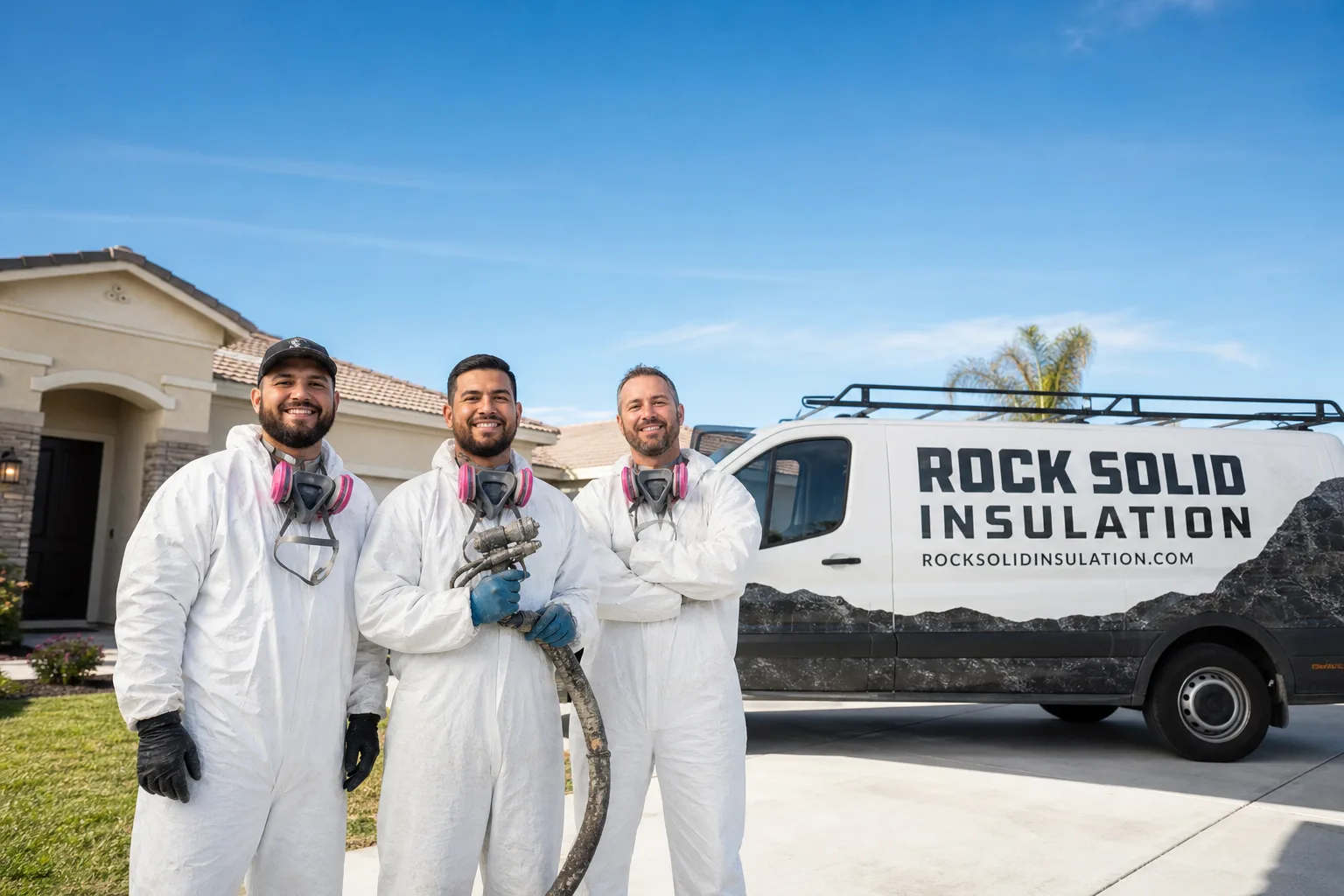
Fast, Reliable Spray Foam Insulation Across March Air Force Base
Spray foam insulation in March Air Force Base is the most effective way to stop the wind-driven dust, afternoon heat, and noise that define this corner of Riverside County. Homes and buildings here sit in an open corridor east of the base, where gusty Santa Ana winds push fine dust into attics and wall cavities, while summer heat turns roof decks into radiators. If you’re tired of struggling rooms, spiking energy bills, or dust that reappears days after you clean, we can help. Our crews work throughout the 92551 zip code and coordinate base access when needed. Call (855) 798-0822 for a free estimate and a straight answer about what your building actually needs.
Why Rock Solid Insulation Is March Air Force Base’s Preferred Spray Foam Insulation Company
Ruben Calloway leads a team that understands this area differently than a general insulation outfit. March Air Force Base is a working military installation, and we handle both sides of that reality: the mid-century base housing and support buildings, and the stucco tract homes in the Moreno Valley neighborhoods that fall under the 92551 zip. That dual experience means we don’t blink at access coordination, security check-ins, or working around active operations.
We carry both Icynene and Demilec spray foam systems, two of the most tested open- and closed-cell platforms in the industry. That matters here because the wind and dust demand products that cure reliably and bond to surfaces even when conditions aren’t ideal. Spray Foam Insulation is one of three installation methods we run under one roof, which means our recommendation follows your building, not our equipment limitations.
Homeowners around March Air Force Base tell us the same thing: they want a contractor who shows up on time, explains the trade-offs honestly, and doesn’t push a single product because it’s what’s in the warehouse. That’s how we work. You get performance first, brand second.
Crawl Space Spray Foam Insulation in March Air Force Base
Crawl Space Spray Foam Insulation is one of the highest-impact upgrades for older homes in March Air Force Base, especially the 1950s and 60s base housing where crawl spaces were originally left vented and uninsulated. In this climate, a vented crawl space pulls in hot, dusty air during the summer and lets it migrate up into the living space. Spraying closed-cell foam on the crawl space walls and rim joist area stops that air movement, controls moisture, and keeps wind-driven dust from accumulating under the house. A typical crawl space encapsulation with spray foam in the 92551 area runs $3,800 to $7,500 depending on square footage and access. Homes on Cactus Avenue and similar streets near the base perimeter tend to see more dust intrusion, which makes air sealing the higher priority.
Rim Joist Air Sealing
The rim joist is the band of framing where your floor meets the exterior wall, and it’s a primary entry point for wind-driven air in this area. We spray closed-cell foam here because it bonds tightly to the framing and blocks both air and dust. This single detail can cut drafts noticeably in single-story ranch homes, which make up a large share of the housing stock in and around the base.
Moisture and Dust Control
Open, vented crawl spaces in March Air Force Base collect fine dust during every Santa Ana event. Over time that dust works into insulation and framing, and it migrates upward through floor gaps. Sealing the crawl space with spray foam addresses the root cause rather than just treating symptoms like dusty baseboards or musty odors.
Garage Spray Foam Insulation in March Air Force Base
Garage Spray Foam Insulation makes a bigger difference in March Air Force Base than homeowners expect, and the reason is simple: attached garages here absorb direct afternoon heat through uninsulated walls and flat or low-slope roof sections. By 3 p.m. in July, an uninsulated garage can hit 110 degrees or higher, and that heat radiates into adjacent rooms for hours after sunset. Spray foam on the shared wall and garage ceiling creates a genuine thermal break. A standard two-car garage in the 92551 area typically costs $1,800 to $4,200 to insulate, with the higher end including the roof deck.
Shared Wall and Ceiling Treatment
Most garage heat transfer happens through the wall shared with the house and the ceiling cavity above. We focus spray foam on those two surfaces first because that’s where the energy penalty is greatest. The goal is to keep the garage’s temperature swing from becoming the home’s temperature swing.
Aircraft Noise Reduction
Living near an active military base means aircraft noise is part of the landscape, and garage cavities act like tuning forks for low-frequency sound. Closed-cell spray foam adds mass and air sealing that reduces what comes through the garage wall and roof. It won’t eliminate aircraft noise entirely, but it will take the edge off the rumble during flight operations.
Trusted Brands We Service in March Air Force Base
We install and service spray foam from Icynene and Demilec, two of the most performance-tested foam platforms on the market. Those aren’t exotic brands we special-order; they’re standard inventory because they’re what this environment demands. The same goes for our fiberglass lineup from Owens Corning and Johns Manville, and cellulose from GreenFiber, for homes where a hybrid approach makes sense. Because we’re brand-independent, we recommend by performance data and project requirements, not by supplier agreements. If you already have spray foam from another manufacturer and need assessment or repair, we’ll give you an honest read on what it needs.
Common Spray Foam Insulation Problems We See in March Air Force Base Homes
- Wind-driven delamination on roof decks. The open terrain around the base means Santa Ana winds carry fine dust at high velocity. If foam is applied to a roof deck without proper surface prep and wind containment, that dust interferes with bonding and the foam can separate from the substrate in sheets. We see this most often on flat and low-slope roofs that were re-foamed by crews unfamiliar with local wind conditions.
- Compacted foam around re-penetrated roof areas. March Air Force Base buildings get re-roofed and re-penetrated frequently as HVAC units change and base maintenance cycles continue. Each penetration disturbs the original foam, and if it’s not properly re-sealed, you get thermal bypass and dust intrusion. Older military housing is especially prone to this pattern.
- Curing problems from high-dust, high-wind application. Spray foam needs a relatively clean surface and consistent ambient conditions to cure correctly. Applying it in gusty, dusty conditions without containment leads to poor cell structure, reduced R-value, and off-gassing that lingers in the living space. We schedule and stage our applications around wind forecasts where possible, and use containment barriers when we can’t.
- Inadequate coverage in flat-roof cavities. Flat and low-slope roofs common on mid-century base structures often have shallow rafter bays. Installers who don’t account for the limited depth end up with foam that doesn’t meet code or perform as specified. We measure each cavity and adjust thickness accordingly, which is detail work that generic crews miss.
Pricing for Spray Foam Insulation in March Air Force Base, CA
You should never agree to spray foam work without knowing what drives the number. In March Air Force Base, the cost depends mainly on three things: the surface area being sprayed, the type of foam (open-cell or closed-cell), and access conditions, especially on base where security coordination adds time. Here’s what we see in the current 92551 market:
- Crawl space spray foam: $3,800 to $7,500 depending on square footage and encapsulation scope
- Garage spray foam (walls and ceiling): $1,800 to $4,200 for a standard two-car garage
- Roof deck spray foam: $4,500 to $9,500 for typical flat or low-slope roof areas on older base housing
- Rim joist sealing: $900 to $2,200 as a standalone project
Open-cell foam runs $0.45 to $0.75 per board foot installed. Closed-cell runs $1.10 to $1.75 per board foot. The gap reflects the higher R-value per inch and moisture-resistance of closed-cell. For a free estimate with actual measurements, call (855) 798-0822.
We Also Serve Cities Near March Air Force Base
Our territory covers March Air Force Base and the surrounding communities, including Woodcrest, Riverside, Colton, and Rubidoux. If you’re in any of these areas and need spray foam work, the same team and the same brand lineup apply. We route crews throughout the Inland Empire weekly, so scheduling is usually quick.
Serving March Air Force Base, CA — Our Local Coverage Area
We’re based in the March Air Force Base area and know this community well. Use the map below to see our service coverage — if you’re nearby, we can almost certainly help.
FAQs About Spray Foam Insulation in March Air Force Base
Spray foam performs well here when it’s applied with wind-resistant detailing and proper surface prep. The main risk is dust interfering with foam adhesion on roof decks and exterior-facing surfaces during Santa Ana events. We use containment barriers and schedule applications around wind forecasts, and we select closed-cell foam for dust-exposed areas because it bonds more aggressively to the substrate.
Yes, and it’s often the best option because spray foam conforms to irregular framing and air seals at the same time. The key is working around the building’s existing condition, especially flat or low-slope roof cavities with minimal original insulation, without disturbing lead paint or asbestos materials that may be present in mid-century construction. We assess each building before recommending a scope. Call (855) 798-0822 to schedule that assessment.
Closed-cell spray foam is the right choice for flat and low-slope roofs because it adds structural rigidity, has a higher R-value per inch for shallow rafter bays, and acts as a moisture barrier. On the 1950s – 60s base structures and support buildings we see throughout 92551, closed-cell applied directly to the roof deck is the most durable answer. It also resists the wind-driven dust that open-cell would absorb over time.
We coordinate with base security and the facility point of contact before any work starts. That means submitting the required access documentation, staging crews and materials at the designated entry point, and building schedule buffers for security checks. If you’re a homeowner or facility manager on March Air Reserve Base, call us early in the process so we can align on access requirements and keep the project moving.
Yes, particularly for attached garages where afternoon heat soaks through the shared wall and ceiling. Spray foam on the shared wall and garage ceiling cuts the radiant transfer that keeps adjacent rooms hot after sunset. It also reduces aircraft noise through the garage cavity. A standard two-car garage here runs $1,800 to $4,200. For a quote on your specific garage, call (855) 798-0822.
If you’re dealing with drafty rooms, a sweltering garage, or dust that keeps coming back no matter how often you clean, we can help. Call (855) 798-0822 for a free estimate. We’ll measure, diagnose, and give you a straight recommendation for your specific building.
Written by Ruben Calloway, Owner at Rock Solid Insulation, serving March Air Force Base and the surrounding Inland Empire.