
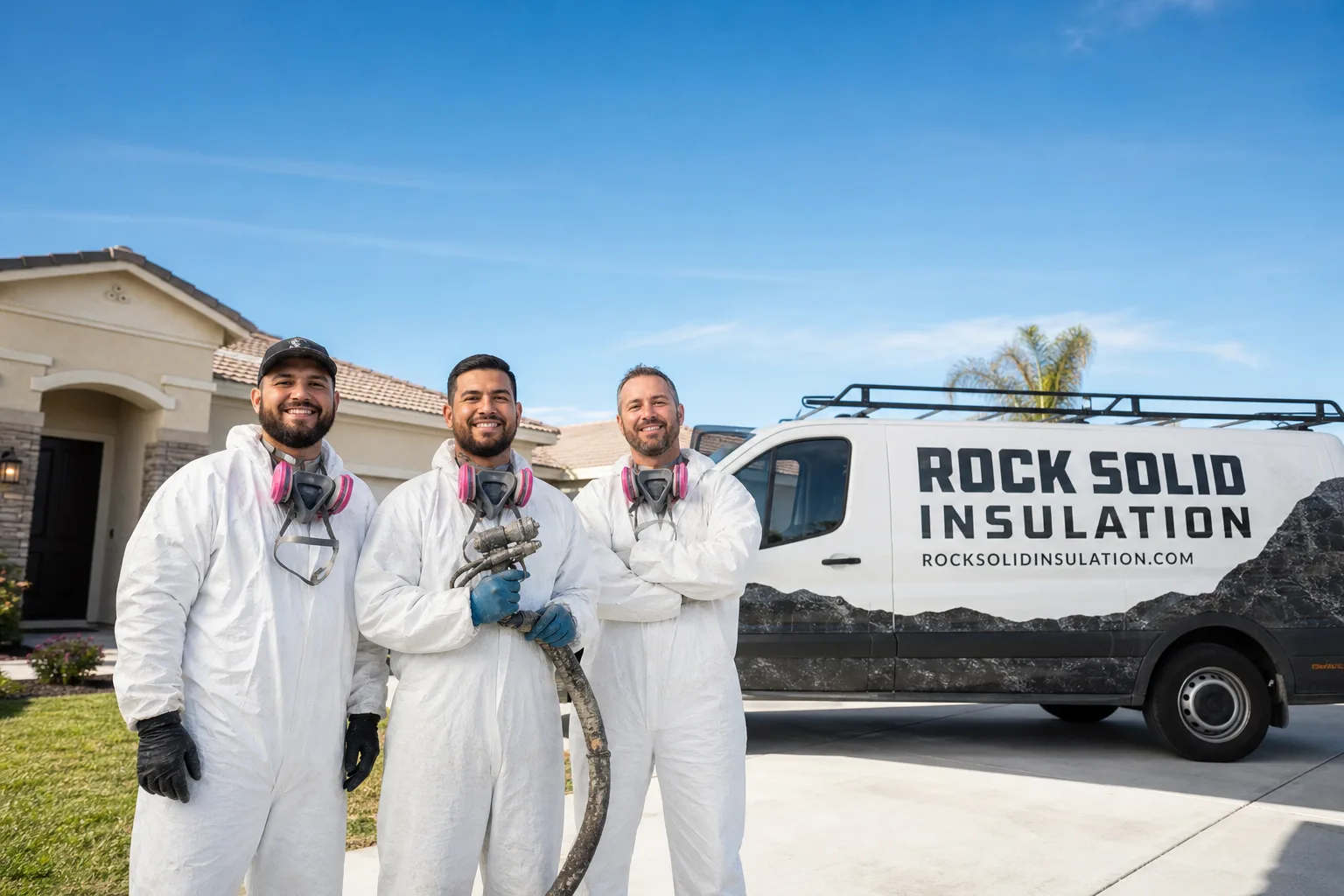
Fast, Reliable Spray Foam Insulation Across Corona
Spray foam insulation in Corona typically costs $1.70 to $3.80 per board foot for open-cell and $2.90 to $6.20 per board foot for closed-cell, with most whole-attic jobs landing between $2,800 and $7,500 depending on square footage and prep work. Our crews run Corona jobs most days of the week, usually within 48 hours of an estimate. Corona’s attic conditions are genuinely different from the rest of the Inland Empire, and the prep work matters more than the foam itself. Call Ruben at (855) 798-0822 for a straight answer on your house.
We know Corona attics. The wind-driven grit off Cajon Pass, the 150°F summer roof decks, the 1970s single-story tracts near downtown with original insulation that has given up. Rock Solid Insulation has installed Spray Foam Insulation in enough Corona homes to know what actually works here, not just what works on a spec sheet. This page is specific to Corona. You won’t find this same material on another city’s page because the conditions aren’t the same.
Why Rock Solid Insulation Is Corona’s Preferred Spray Foam Insulation Company
We approach insulation the way Corona’s housing stock demands: no assumptions, no one-size-fits-all. The south side near Rimpau Avenue has 1960s-70s tract homes with original R-11 batts crushed under decades of Cajon Pass dust. The north and east corridors are mostly 1980s-90s two-story subdivisions with their own air-sealing gaps. Then there’s the foothill stretch off Chase Drive and up toward the Cleveland National Forest boundary, where wind-driven ash and grit infiltrate through soffit vents all season long. We tailor the foam system to the specific attic, because applying closed-cell where open-cell makes sense (or vice versa) costs homeowners real money.
What builds trust in Corona is showing up, pulling back the attic access panel, and telling a homeowner exactly what we’re seeing. We don’t sell a single brand. We carry Icynene and Demilec for spray foam, plus Owens Corning, Johns Manville, Knauf, Rockwool, CertainTeed, and GreenFiber for other methods. That brand independence means our recommendation follows what your attic actually needs, not the one product line we happen to stock. Ruben Calloway has built the company around materials integrity, and it shows in how our Corona jobs hold up season after season.
Response time to Corona: we schedule estimates within 24 hours and installation within 2 to 4 days in most cases. For homeowners in 92882, 92883, 92877, and 92878, we’ve got crews running through the city weekly. That local coverage means when a homeowner near Dos Lagos or off Ontario Avenue finds attic heat bleeding into the upstairs bedrooms in July, we can get eyes on it fast.
Garage Spray Foam Insulation in Corona
Garage Spray Foam Insulation in Corona is one of the most effective fixes for converted garages, attached garages that double as workshops or home gyms, and garage ceilings that bake under the afternoon sun. Corona’s day-night temperature swing puts a garage ceiling through extreme thermal cycling, and an uninsulated or under-insulated garage can spike 20°F hotter than the living space. We see this constantly in 1980s-90s subdivisions across north and east Corona, where garage conversions were popular additions but original insulation boundaries were never properly sealed. A typical garage ceiling application in Corona runs $1,100 to $3,400 depending on square footage, access, and whether we remove existing crumbling insulation first.
What The Job Actually Involves
We start by checking what’s already in the garage ceiling and above it. Often there is either nothing, or fiberglass batts that have slumped and lost contact with the drywall. When we apply spray foam to the garage ceiling, the foam expands into every joist bay, bonding to the subfloor above. That stops the heat transfer that makes a converted garage feel like an oven by 3 p.m.
When Corona Homeowners Call Us For This
The common trigger is a garage conversion that was permitted, or not, years ago, and now the room behind the garage absorbs every degree of attic heat. Another trigger is a bedroom above the garage that stays comfortable in winter but becomes unusable in summer. Spraying the garage ceiling with closed-cell foam at 2 inches to 3 inches in those joist bays drops surface temps dramatically, and the energy savings show on the next Riverside Public Utilities bill.
Closed Cell Spray Foam Insulation in Corona
Closed Cell Spray Foam Insulation in Corona suits homes that want the highest R-value per inch and a vapor barrier in a single pass. Corona’s summer attic temperatures routinely exceed 150°F, and a closed-cell application at 2 to 3 inches delivers an R-14 to R-21 barrier that also stops moisture migration. For homes in Corona’s foothill neighborhoods off Chase Drive, where pass-driven dust and occasional humidity from marine-layer intrusions linger, closed-cell foam’s closed-cell structure resists both moisture and grit adhesion better than open-cell. Expect $2,900 to $7,500 for a full attic application in a Corona home, with garage ceiling applications on the lower end.
Why Corona Attics Favor It In Many Cases
Closed-cell foam’s compressive strength works well in Corona attics used for light storage, which are common in older single-story homes near downtown where crawl space storage is limited. Also, because closed-cell foam does not absorb water, it holds up better than open-cell in attics where wind-driven grit has already damaged the soffit screens. We don’t pretend closed-cell is the right answer for every Corona home; what’s right depends on the attic condition, roof type, and whether the house sits in a dust-exposed corridor or a more sheltered neighborhood.
What Homeowners Should Know About Prep
Closed-cell foam bonds aggressively, but not to crumbling batts, dust, or loose debris. That’s why the prep step in Corona is non-negotiable. We remove crusted legacy insulation before spraying, then seal top plates and any framing gaps where air leaks undermine the thermal envelope. Skipping that work means foam applied over compressed, dust-packed batts that will eventually delaminate. Ruben has been clear with his crews: foam is only as good as the surface it bonds to.
Trusted Brands We Service in Corona
We carry and install Icynene and Demilec spray foam systems in Corona, two of the most performance-tested foam platforms in the industry, and we also handle Reflectix repair in Corona. Beyond spray foam, we stock Owens Corning and Johns Manville fiberglass for homes where a combination approach makes more financial sense, plus Rockwool mineral wool for fire-rated and sound-sensitive applications. For Corona customers, we keep local stock of the common accessory materials, replacement soffit screens, sealants, and foam thickness gauges, so turnaround on mid-job adjustments is quick. We aren’t tied to any supplier contract, which means if Demilec’s closed-cell makes more sense for your garage ceiling than an open-cell alternative, we’ll tell you that directly.
Common Spray Foam Insulation Problems We See in Corona Homes
- Pass-driven grit embedded in fresh foam. Corona’s position at the Cajon Pass convergence means soffit vents pull fine dust into the attic during application. If we don’t mask the spray zone, that grit embeds in the first few millimeters of foam and creates pinholes that compromise the air barrier.
- Legacy batts never removed before spraying. We find original R-11 batts in 1960s-70s south-side homes compressed to R-4 or less, often under a crust of dust. Spraying over that traps moisture against the drywall and gives the foam nothing to bond to.
- Garage conversion thermal bridges. Off Chase Drive and throughout north Corona, converted garages create irregular framing where the original garage slab, wall, and ceiling all meet. Sprayed too thin in those corners, the foam leaves thermal bridges that spike heat gain in adjacent rooms.
- Delamination at the soffit line. In the foothill homes near the Cleveland National Forest boundary, wind-driven ash settles on top of cured foam and pulls it away from the deck edge over time. We see this in Coronas’ exposed attic zones more than in sheltered neighborhoods in Norco or Eastvale.
Pricing for Spray Foam Insulation in Corona, CA
Here are the ranges we quote for Corona homes, based on actual jobs: open-cell spray foam runs $1.70 to $2.80 per board foot, closed-cell runs $2.90 to $4.80 per board foot, and full-attic applications in a typical 1,400 to 2,200 square foot Corona home land between $2,800 and $7,500. Garage ceiling-only applications run $1,100 to $3,400. The bigger variable in Corona isn’t foam type, it’s prep: if we’re removing 50 years of compressed, dust-caked batts before spraying, that labor adds to the total. We’ll give you an exact number after looking at your attic, and the estimate is free. Call (855) 798-0822 to schedule one.
We Also Serve Cities Near Corona
Beyond Spray Foam Insulation in Corona, our crews regularly work in Home Gardens, El Cerrito Corona, Eastvale, and Norco. If you live in one of the neighboring communities and need spray foam insulation, call us. The same crew standards apply; the attic conditions may shift slightly, but the obsession with prep work does not.
Serving Corona, CA — Our Local Coverage Area
We’re based in the Corona area and know this community well. Use the map below to see our service coverage — if you’re nearby, we can almost certainly help.
FAQs About Spray Foam Insulation in Corona
No. Spray foam needs a clean, solid surface to bond to, and the decades of Cajon Pass dust packed into those original batts creates exactly the wrong surface. We remove the crusted batts, air-seal the framing below, then apply foam to bare deck and joist surfaces. That prep step is the difference between a foam blanket that stays put and one that peels away in a year. Call (855) 798-0822 and we’ll tell you what’s actually up there.
When pass-driven grit gets pulled into the spray zone by soffit vents, the dust can embed in the foam during its first several minutes of cure, leaving a rough film and sometimes a faint earthy smell. It can also interrupt chemical adhesion at the surface. We mask and seal the spray zone first, which prevents that contamination entirely. Not every Corona installer does this, and it shows in the finished product.
For a garage conversion with a bedroom or living space above it, closed-cell foam is often the stronger choice because it delivers roughly double the R-value per inch and includes a built-in vapor barrier. That matters in Corona, where garage ceilings can exceed 150°F in summer. For a detached workshop that just needs moderate air sealing, open-cell saves money and still stops most of the heat gain. We’ll evaluate the actual space before recommending anything.
Spray foam handles Corona’s thermal cycling better than fiberglass because it stays in contact with the building assembly through every expansion and contraction cycle. We see 50-degree swings between Corona’s summer daytime highs and nighttime lows on a regular basis, and closed-cell foam’s rigidity helps it hold position under repeated thermal stress. That durability is why foam works well in Corona attics that get the full brunt of the afternoon sun.
Yes. Homes in the foothill neighborhoods off Chase Drive and near the Cleveland National Forest boundary face wind-driven ash and dust that we rarely see in the flatlands. We recommend closed-cell foam in those attics because the harder surface resists grit adhesion better than open-cell, and we pay extra attention to the soffit line where wind blows debris inward. The approach isn’t fancy; it’s just matched to what those attics actually experience.
Ready to get your Corona attic sealed properly? Call Rock Solid Insulation at (855) 798-0822 for a free attic assessment and a straight estimate. We serve all of Corona, including 92882, 92883, 92877, and 92878, and we’ll tell you exactly what your attic needs and what it will cost. No pressure, just the right product for your situation.
Written by Ruben Calloway, Owner at Rock Solid Insulation, serving Corona and the Inland Empire.