
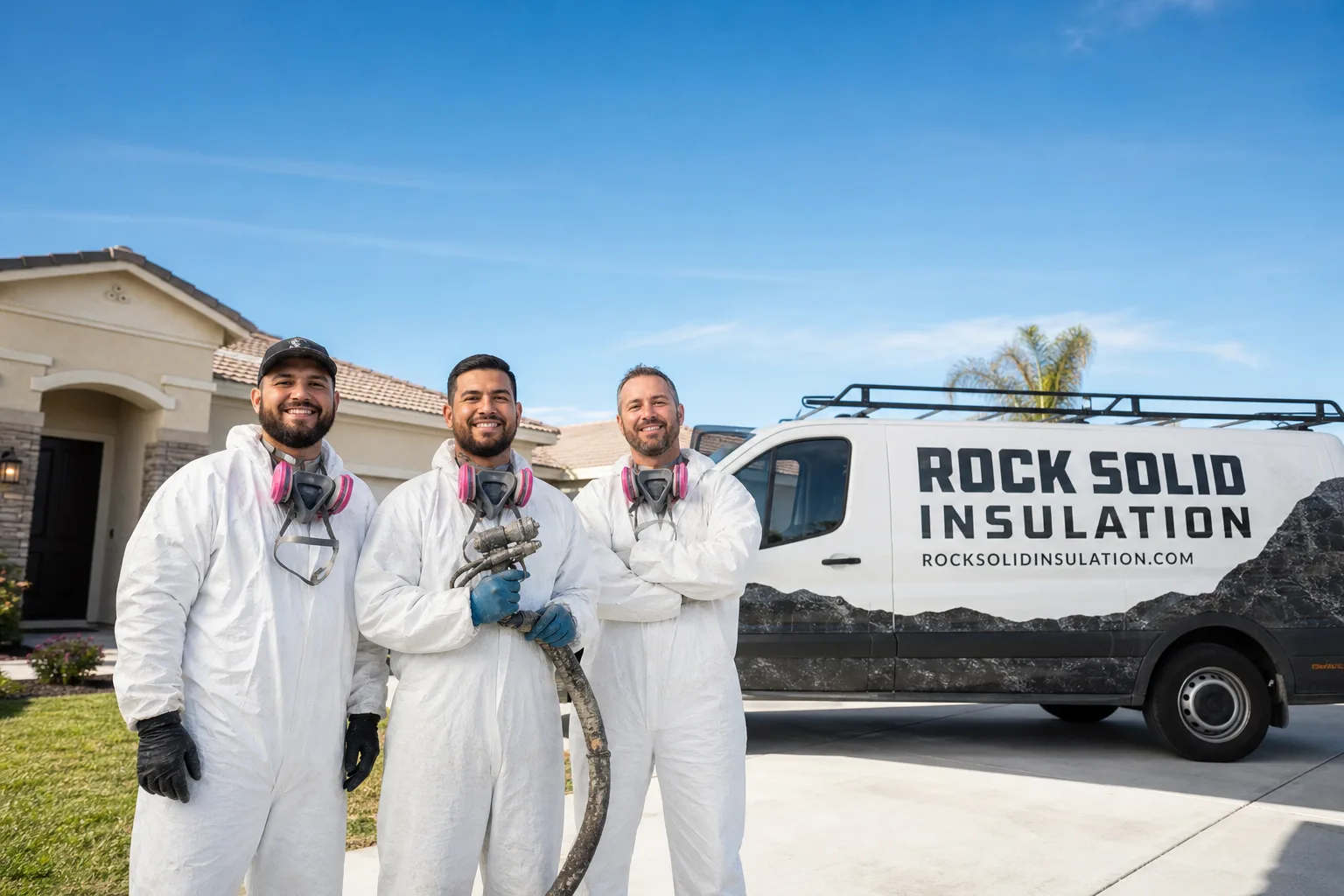
Fast, Reliable Spray Foam Insulation Across San Antonio Heights
Spray foam insulation in San Antonio Heights usually costs between $1,800 and $7,200 depending on whether we’re air-sealing an attic, insulating a basement rim joist, or foaming the vaulted ceiling of a custom foothill home. Most jobs are completed in one to two days, and we can typically reach a San Antonio Heights address within 60 to 90 minutes from our Ontario shop. The homes up here on the alluvial bench below the San Gabriel Mountains are not like the tract housing down in Upland or Rancho Cucamonga. They’re older, custom, often built into a slope with exposed beams and odd rooflines, and they demand a spray foam contractor who understands how mountain air moves through a structure. That’s exactly the work Ruben Calloway and our crew at Rock Solid Insulation do every week in ZIP code 91784. If you’re feeling drafts near your eaves or your upstairs rooms swing fifteen degrees between afternoon and midnight, call (855) 798-0822 for a free estimate.
Why Rock Solid Insulation Is San Antonio Heights’s Preferred Spray Foam Insulation Company
We carry eight insulation brands including Owens Corning and Rockwool, which means nobody here is steering you toward a house product because a supplier contract says so. For San Antonio Heights specifically, we stock closed-cell and open-cell foam systems from Icynene and Demilec, two platforms that have years of independent performance testing behind them and that hold up under the daily temperature swings this foothill community sees.
Our service area includes every street from Mountain Avenue east toward the canyon, and we know the housing stock well. We’ve worked inside mid-century custom homes off 24th Street where original fiberglass had been pulled apart by wind and raccoons, and we’ve foamed newer hillside builds near the Euclid Avenue corridor that needed careful air-sealing around recessed lighting and skylights. San Antonio Heights customers call us because we specify before we spray. That’s the whole job.
Ruben Calloway has been running insulation crews in the Inland Empire long enough to know that a foothill home off Mountain Avenue needs a different foam than a stucco tract house in Montclair. We carry products from Johns Manville and Knauf when fiberglass hybrid approaches make more sense, and we’re not married to any single method. Call us at (855) 798-0822 and we’ll walk you through what your specific home actually needs.
Spray Foam Attic Insulation in San Antonio Heights
Spray foam attic insulation in San Antonio Heights is the most common retrofit we handle, and it typically runs $2,200 to $5,800 for a full attic application in a foothill custom home. What makes attics different up here is that many were built with vaulted or exposed-beam ceilings, cathedral-style rafter bays, and eave gaps that face directly into Santa Ana wind corridors. That’s a fundamentally different air-sealing job than a standard flat-ceiling tract home down in Claremont.
Air Sealing Before Foam Goes Down
The single biggest mistake we see in San Antonio Heights attics is new foam sprayed over old, wind-scoured fiberglass that was never removed or air-sealed. Any gap underneath new foam is a thermal bypass, and it’s worse up here because cool mountain air pulls through those bypasses at night. We remove compromised insulation, seal the framing intersections, then spray.
Vaulted Ceiling and Exposed Beam Work
Foam on a vaulted ceiling must expand and contract with the structure. Homes on the alluvial bench experience daily temperature swings of 30 degrees or more, and that movement is real. Closed-cell foam from Demilec gives us the rigidity plus adhesion needed on exposed rafter bays without cracking loose over time.
Spray Foam Wall Insulation in San Antonio Heights
Spray foam wall insulation in San Antonio Heights is typically part of a larger retrofit, and costs run from $1,800 for a single rim joist or garage wall to $6,500 for whole-wall cavity work in an older custom home. Walls in this area are not uniform. Some are original 2×4 framing with minimal sheathing, others are adobe or masonry from decades ago, and the newer hillside builds often have steel framing or complex window walls.
Rim Joist and Band Board Sealing
The rim joist is where the floor framing meets the foundation, and in foothill homes it is often the biggest source of air leakage. Cool downslope air moves through those gaps every night, carrying dust and smoke particles. Spraying a closed-cell rim joist in a 91784 home seals the envelope where it matters most.
Whole Wall Cavity Retrofits
When walls are opened for renovation, we spray Icynene open-cell foam into the stud bays to create an air barrier and a dense thermal envelope. With the Santa Ana winds and wildfire smoke season here, an airtight wall assembly is not just an energy upgrade. It’s a fire-hardening measure. Fire-resistant options are available, and we specify them for homes in the wildland-urban interface zone.
Trusted Brands We Service in San Antonio Heights
We install and service spray foam systems from Icynene and Demilec, and we stock the compatible accessory components locally so San Antonio Heights customers aren’t waiting on parts from a warehouse in another state. If you need a specific Rockwool product for fire-rated or acoustically sensitive areas of your foothill home, we keep that in inventory too. For hybrid projects where spray foam pairs with fiberglass batts in non-critical cavities, we carry Owens Corning, Johns Manville, and Knauf products. That brand spread means you get a recommendation based on your attic geometry, wall depth, and wildfire exposure, not on what our shop happens to have on the truck. Performance drives the call.
Common Spray Foam Insulation Problems We See in San Antonio Heights Homes
- Wind-scoured attic insulation under new foam. Santa Ana winds have spent years pulling loose fiberglass away from the eave edges of many foothill attics. Any spray foam applied over that compromised layer locks in thermal bypasses that defeat the entire upgrade.
- Brittle, cracking foam from rapid temperature swings. The daily thermal pendulum here, blazing afternoons followed by genuinely cool mountain-fed air draining downslope, places stress on foam that flatland homes never experience. A foam spec that works in Upland can micro-crack on a hillside lot off Euclid.
- Gaps behind foam in exposed-beam ceilings. Vaulted ceilings in mid-century custom homes move more than flat ceilings. If foam is applied without handling structural joints and rafter-to-beam connections, it delaminates within a few seasons.
- Ember intrusion through unsealed eave gaps. Homes in the wildland-urban interface zone need every attic penetration sealed. We find soffit vents and eave gaps facing directly into the wind corridor that would funnel embers straight into the attic during a fire event.
Pricing for Spray Foam Insulation in San Antonio Heights, CA
We Also Serve Cities Near San Antonio Heights
Our crews work throughout the northeast Inland Empire, including Upland, Claremont, Rancho Cucamonga, and Montclair. Many of our San Antonio Heights clients have family or rental properties in those neighboring cities, and we’re glad to extend the same service there. If you’re reading this from a neighboring town, our Spray Foam Insulation team covers the whole corridor from Ontario up into the foothills.
Serving San Antonio Heights, CA — Our Local Coverage Area
We’re based in the San Antonio Heights area and know this community well. Use the map below to see our service coverage — if you’re nearby, we can almost certainly help.
FAQs About Spray Foam Insulation in San Antonio Heights
Why is spray foam insulation different for San Antonio Heights homes compared to nearby Upland?
San Antonio Heights sits on the alluvial bench at the base of the San Gabriel Mountains, where homes experience a daily thermal swing that Upland valley homes do not. Intense afternoon sun bakes the slopes, then cool mountain air drains downslope after sunset. That rapid temperature cycling stresses spray foam in ways that demand a different spec, usually a closed-cell formulation with the right elongation properties to keep from cracking. Upland homes sit in a more stable thermal zone, so the foam requirements are less demanding.
Can spray foam help with Santa Ana wind and ember intrusion in foothill homes?
Yes, and for ZIP code 91784 this is one of the strongest arguments for spray foam. Closed-cell foam applied to eave gaps, soffit transitions, and rim joists creates an air barrier that physically blocks the wind corridors that pull heat and smoke into an attic. Properly specified and installed foam also seals the small openings where wind-driven embers enter during wildfire events. Many San Antonio Heights homes are in the wildland-urban interface, so this sealing work is particularly relevant. Call (855) 798-0822 to have us assess your attic’s vulnerability.
What should be done before spraying foam over existing attic insulation in San Antonio Heights?
All existing wind-scoured, animal-disturbed, or compressed fiberglass must be removed from the areas being foamed. Air sealing of every framing intersection, eave penetration, and soffit gap has to happen before any foam goes down. In foothill attics, skipping this step hides thermal bypasses and compromises the entire air barrier. Our crew at Rock Solid Insulation handles the full removal and sealing process so the foam application performs as designed.
How does spray foam perform in vaulted or exposed-beam ceilings common in San Antonio Heights custom homes?
Closed-cell spray foam from Demilec performs well in vaulted or exposed-beam ceilings when it is installed with attention to structural movement and when fire-resistant barriers are applied wherever local code requires. These are common ceiling types in San Antonio Heights, particularly in the mid-century custom homes built into the hillside. The foam has to flex with daily thermal movement, so the right product and the right install method matter more than in a flat, truss-framed attic.
Are there fire-resistant spray foam options for San Antonio Heights wildfire zones?
Yes. Certain closed-cell spray foam formulations are designed with fire-resistant properties that slow flame spread and contribute to a more resilient building envelope. We also pair foam with radiant-barrier coatings and fire-resistant barriers where conditions warrant. Homes in the wildland-urban interface zone north of Upland and east of the canyon benefit most from these options. Call (855) 798-0822 and we’ll discuss what your specific home needs.
Get a Free Spray Foam Insulation Estimate in San Antonio Heights
If your San Antonio Heights home runs hot in the afternoon and cold by midnight, or you’re noticing drafts near your eaves and higher energy bills than your valley friends report, call Rock Solid Insulation at (855) 798-0822. Ruben Calloway will come out to your property in ZIP code 91784, inspect your attic and walls, and give you a straightforward estimate with real numbers. We serve every street from the Euclid Avenue corridor to the hillside properties near the foothill canyons, and we can usually reach you the same week you call.
Written by Ruben Calloway, Owner at Rock Solid Insulation, serving San Antonio Heights and the surrounding Inland Empire foothill communities.