Fast, Reliable Attic Insulation Across Woodcrest
Attic insulation in Woodcrest boils down to one thing: taming an attic that can hit 150°F before noon in July. Most homes here, built between the 1980s and early 2000s, went up with modest R-value fiberglass batts that the inland heat has spent decades flattening. We work throughout the 92508 ZIP every week, and we know exactly what these tract and semi-custom homes need. If your upstairs rooms run 10 – 15 degrees hotter than downstairs, your attic is the problem. Call (855) 798-0822 and we’ll diagnose it honestly.
Why Rock Solid Insulation Is Woodcrest’s Preferred Attic Insulation Company
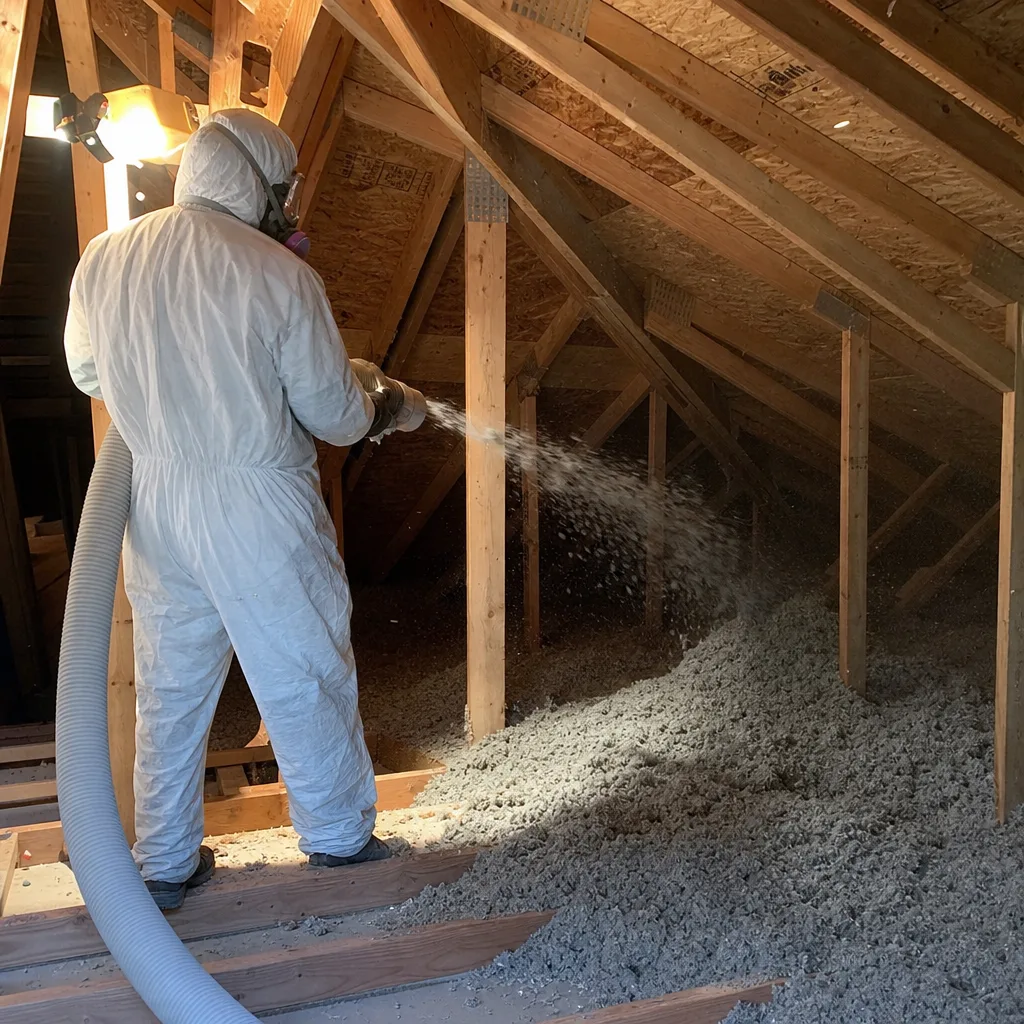
We’re not a one-product crew trying to sell you whatever’s on the truck. Our Attic Insulation team carries three installation methods, blown-in, spray foam, and batt, plus a radiant barrier option that most contractors in Riverside County don’t stock. That means when we walk a Woodcrest attic, the recommendation follows what the home actually needs. Ruben Calloway built the company on that principle: match the material to the job, not the job to the material.
Our work in Woodcrest spans the subdivisions off Van Buren Boulevard, the larger lots north of Mockingbird Canyon, and the stucco two-story tracts that dominate the 92508 corridor. Homeowners here tell us the same thing consistently: their original insulation was never re-evaluated after installation. We find it on almost every retrofit. Compressed, settled, sometimes only R-4 to R-7 worth of effective coverage from a label that claimed R-19. What gets us repeat calls is the honesty about what’s actually salvageable and what isn’t.
We can typically get a crew out to Woodcrest within 24 to 48 hours for estimates, and same-week installs are common depending on the scope. For anyone in the citrus-belt subdivisions dealing with a house that won’t cool below 80°F on a 100°F day, we treat that as urgent.
Radiant Barrier in Woodcrest
Radiant Barrier in Woodcrest matters more than in almost any other Riverside County market because your attic decking routinely exceeds 150°F during summer afternoons, which is heat that transfers straight through your ceiling into living space. A radiant barrier is a reflective foil, typically stapled to the underside of the roof rafters, that bounces up to 97% of that radiant heat back out before it ever reaches your insulation. In a properly vented 1980s – 2000s pitched attic, pairing a radiant barrier with refreshed insulation is frequently the single highest-impact energy upgrade a Woodcrest homeowner can make.
When insulation alone isn’t enough
Even fresh R-38 blown-in insulation has to fight against a 150°F deck cooking from above. Insulation slows conductive heat transfer. It does nothing to stop radiant heat from the sun beating down on your roof deck. On a 105°F Woodcrest afternoon, the deck can hit 150°F and keep radiating downward for hours after the sun dips. A radiant barrier stops that transfer at the source. That’s the difference between an attic that stabilizes at 100°F and one that stabilizes at 130°F.
What a Woodcrest radiant barrier retrofit involves
We staple the foil to the rafters across the entire attic, leaving the existing vent path at the soffits and ridge clear. On the south- and west-facing slopes, which take the brunt of the inland sun, we’ll often double-check eave vent locations and add baffles if the original home went in without them. The material is maintenance-free once installed and lasts decades in a dry attic environment. It does not replace insulation, it works alongside it.
Cost note: for a typical 1,800 to 2,400 square foot Woodcrest tract home, a radiant barrier install runs approximately $1,700 to $3,100 depending on roof pitch, attic accessibility, and whether we’re pairing it with an air-seal and blow-in.
Attic Cleaning Services in Woodcrest
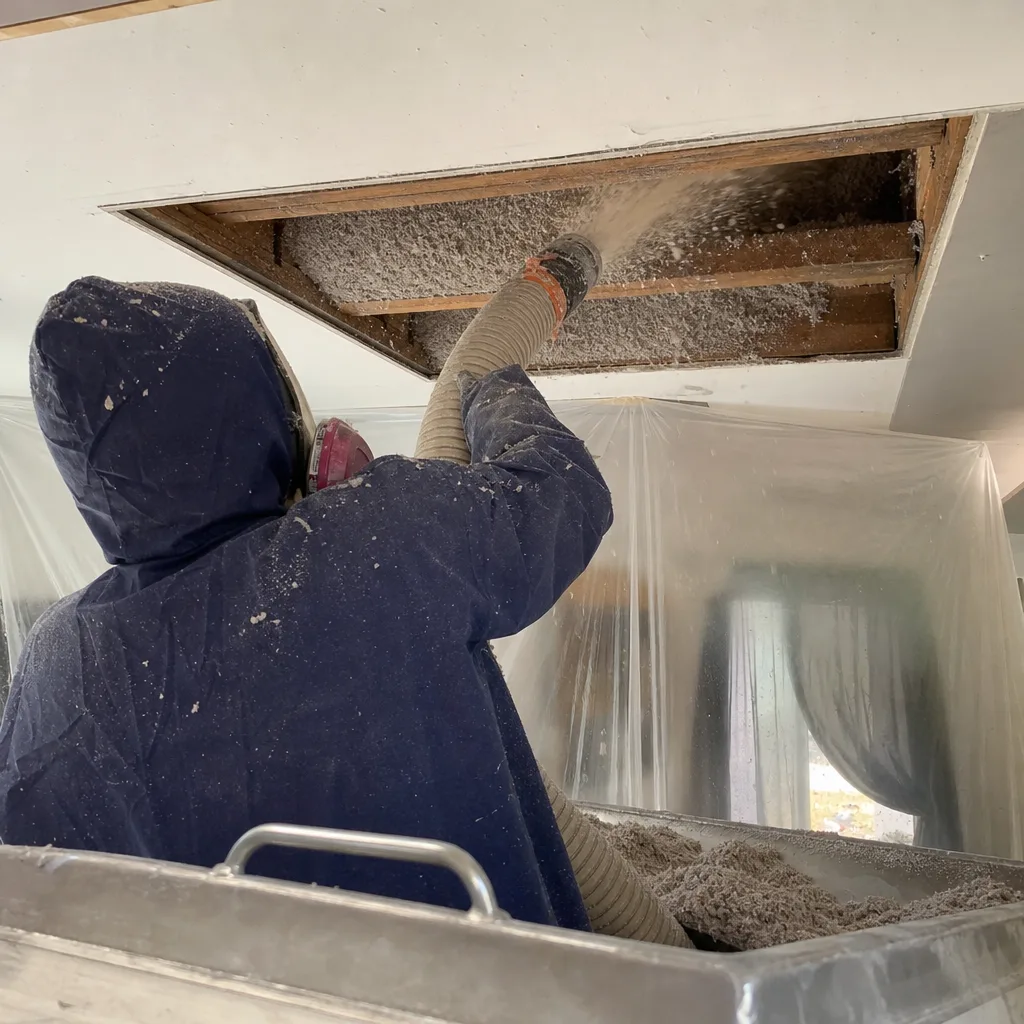
Attic Cleaning Services in Woodcrest are a pre-installation step we recommend for about 70% of the retrofit jobs we quote here. Two decades of inland heat and dust leave attics in the 92508 ZIP full of broken-down fiberglass dust, construction debris from the original build, rodent droppings, and sometimes the remnants of a long-forgotten AC duct leak. Installing new insulation directly over that mess locks in the air-quality problems and leaves old compressed material beneath the new product. We remove it all first.
What we pull out of Woodcrest attics
The list is predictable in this area: flattened R-11 batts, mouse and roof-rat activity that thrives in these larger semi-rural lots, old cellulose settled to half its depth, and dust layers an inch thick on every truss. A full removal on a typical two-story stucco tract home takes one to two days with our crew. After the deck is clean, we can actually see the top plates and penetrations that need sealing.
Why cleaning comes before new insulation
Adding new insulation over contaminated or compacted material creates exactly the conditions you’re trying to eliminate. The new product sits on top of the old, air still leaks through the places you couldn’t see, and you’ve paid for an upgrade that underperforms from day one. In Woodcrest’s heat, that underperformance shows up in the summer electric bill. Full removal and air-sealing first is the only sequence that makes sense for homes that have gone 20 – 35 years without any attic work.
For a full attic cleanout on a Woodcrest tract home, costs generally fall between $1,100 and $2,400 depending on attic size, contamination level, and how much debris is up there.
What happens when you call
- 1
A real person answersNo phone trees — you reach a local pro.
- 2
You get an upfront price rangeHonest numbers before anyone is dispatched.
- 3
A background-checked tech heads outLicensed & insured, dispatched right away.
- 4
You approve before work beginsNothing starts until you say go.
Trusted Brands We Service in Woodcrest
We don’t lock ourselves to one manufacturer, and that matters in Woodcrest because the right product depends on your roof configuration and cooling budget. We install Owens Corning and Johns Manville loose-fill for most residential blown-in work, and keep GreenFiber cellulose on hand for homeowners who want a denser, more air-resistant packed application. For spray foam jobs, our crews run Icynene open-cell and Demilec closed-cell systems, both of which perform exceptionally in the high heat. Four brand options mean we can match the material to your attic’s specific heat profile, not to whatever supplier gave us the best quarterly deal.
Common Attic Insulation Problems We See in Woodcrest Homes
- Settled, compressed fiberglass from the original build. Homes built in Woodcrest between 1985 and 2005 typically started with R-11 to R-19 batts. After 20 – 35 years of 150°F decking heat, those batts are often compressed to half their original loft, meaning the actual R-value is far below what the label claimed on install day.
- Unsealed top plates and can-light penetrations. The gap where interior walls meet the attic floor is a direct chimney for 150°F attic air to pour into second-floor bedrooms. We find these unsealed on nearly every original-condition Woodcrest home, and it’s the first thing we fix before any new insulation goes in.
- Blocked or missing soffit vents. Many of the 1990s tracts in the 92508 ZIP went in with enough ridge vent but insufficient intake at the eaves. Without balanced airflow, the attic can’t shed heat even with proper insulation depth. We check and correct ventilation as part of every attic project.
- Insulation that was never upgraded past code minimums. Riverside County’s mid-1990s energy code allowed fiberglass depths that we now know are insufficient for a 100°F+ summer climate. A house that met code in 1995 is running at roughly half the recommended attic insulation level for this region today.
Pricing for Attic Insulation in Woodcrest, CA
A typical attic insulation project in Woodcrest runs between $2,900 and $5,800 for a standard 2,000 square foot tract home, including removal of old material, air-sealing, and blown-in insulation to R-38. If you’re adding a radiant barrier on top of that, figure another $1,700 to $3,100. Smaller homes or simple top-up jobs without full removal land between $1,400 and $2,500. The biggest variables are attic accessibility, how many can lights and ceiling penetrations need sealing, and whether we’re repairing baffles. We give free estimates, and the number we quote is the number you pay. Call (855) 798-0822 and we’ll walk the attic with you, not just hand over a number.
We Also Serve Cities Near Woodcrest
Our crews cover homes throughout the Riverside corridor from our Ontario headquarters, so if you live just over the line in Woodcrest or nearby in March Air Force Base, Riverside, Rubidoux, or Grand Terrace, we can reach you just as quickly. Same evaluation process, same pricing, same eight-brand lineup. Neighboring ZIPs don’t get a different company.
Serving Woodcrest, CA — Our Local Coverage Area
We’re based in the Woodcrest area and know this community well. Use the map below to see our service coverage — if you’re nearby, we can almost certainly help.
FAQs About Attic Insulation in Woodcrest
Because the roof decking in a Woodcrest summer routinely exceeds 150°F, and standard fiberglass or cellulose insulation only slows conductive heat transfer, not radiant heat. A radiant barrier reflects up to 97% of that heat before it ever hits the insulation, which is why it’s the first recommendation we make on south- and west-facing roofs in the 92508 ZIP. In coastal SoCal markets with mild attic temperatures, the upgrade never pays for itself. In Woodcrest, it’s often the highest-return energy improvement available. Call (855) 798-0822 for an attic assessment and quote.
In most cases, almost nothing. Original R-11 batts installed in 1990s Woodcrest construction have been baked by 20 – 35 summers of extreme decking heat, which causes the glass fibers to lose their loft and compress. We routinely measure effective R-values of R-4 to R-7 in attics where the original label said R-19. On a two-story stucco tract home off the Van Buren corridor, our crew found the original batts compressed to little more than dust-stained matting under a deck that read over 150°F at midday. They were doing essentially nothing.
Every five to seven years if you’ve had a major retrofit, and immediately if you’ve noticed uneven temperatures, sudden summer AC bill spikes, or visible dust around ceiling fixtures. The heat here accelerates insulation settling and can expose gaps over time even in well-done installs. A quick attic inspection catches air leaks early before they cost you another $400 summer.
It involves removing all old insulation, debris, and contamination down to the bare decking, then cleaning the surfaces so air-sealing can be applied effectively. In Woodcrest specifically, this matters because the original fiberglass has broken down into fine dust that prevents any new foam or caulk from adhering to top plates and penetrations. You can’t air-seal a dirty attic. Doing it before new insulation is the only sequence that gives you a clean thermal boundary and an attic that actually performs.
No, a properly installed radiant barrier is spec’d for continuous high-temperature exposure and doesn’t degrade in a dry attic environment the way fiberglass does. The foil material we install handles the 150°F+ conditions in Woodcrest attics without any measurable performance loss over decades. What degrades it is surface contamination, which is why we install it only after the attic is cleaned and ventilation is confirmed working.
If your Woodcrest attic is hot enough to feel like a sauna when you pull down the ladder, we can fix that. Call Rock Solid Insulation at (855) 798-0822 for a free estimate, or use the form below and we’ll schedule a walk-through. Ruben Calloway and the rest of our team work Woodcrest every week, and we know exactly what these attics need. Estimates are free, upfront, and specific to your house, not a generic square-footage guess.
Written by Ruben Calloway, Owner at Rock Solid Insulation, serving Woodcrest and the inland Riverside corridor. Our team specializes in attic insulation, radiant barrier retrofits, and whole-home air-sealing for the region’s hot-summer climate.