Fast, Reliable Attic Insulation Across Crestline
If your Crestline home was built as a summer cabin and now shivers through San Bernardino Mountain winters, the problem usually isn’t your heater. It’s your attic. Most Crestline attics in the 92325 ZIP have bare joists, zero air sealing, and little to no insulation because the homes were never designed for year-round cold. Rock Solid Insulation fixes that legacy construction problem properly. We air-seal first, then insulate to R-49 with materials matched to mountain conditions. Call (855) 798-0822 for a free attic assessment in Crestline, and we’ll come up the hill within a day or two.
Why Rock Solid Insulation Is Crestline’s Preferred Attic Insulation Company
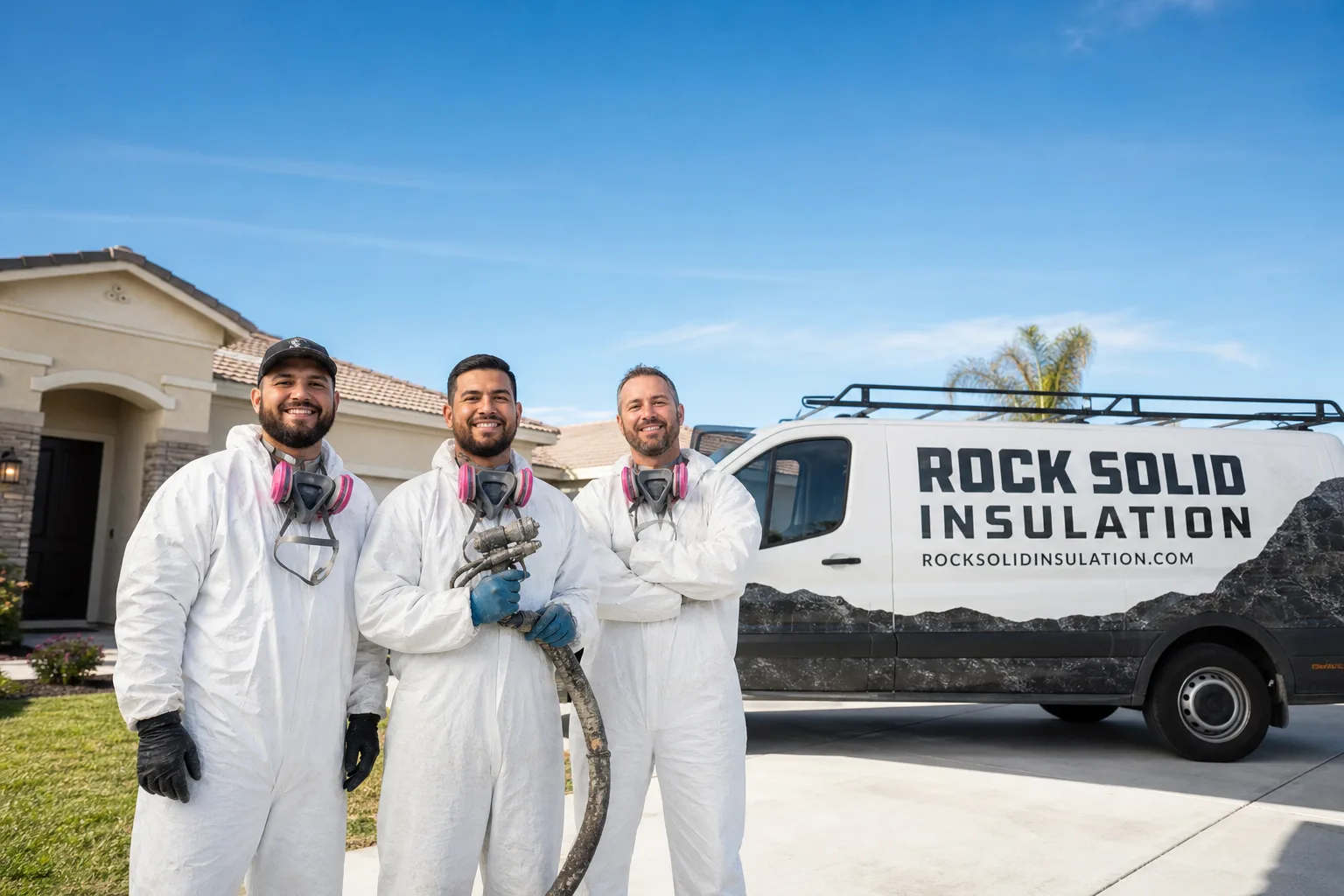
Crestline homeowners call us after they’ve lived through one too many February nights with frozen pipes and a $400 gas bill. Ruben Calloway runs our crews, and he’s built the company around a simple rule: seal the envelope before you insulate it. That discipline matters more in Crestline than almost anywhere else we work. Mountain air finds every gap in a 1960s cabin’s framing and carries heat straight out. Our team has walked through dozens of attics near Lake Gregory, Valley of Enchantment, and the neighborhoods off Lake Drive, and we know the construction patterns of every era up here.
We don’t guess. We inspect access hatches, rim joists, can lights, and vent paths before we recommend a single product. Homeowners tell us the same thing after the job: the house finally holds a consistent temperature from morning to night. That’s the measure that counts. Call (855) 798-0822 and we’ll schedule a Crestline attic inspection that actually explains what’s wrong and what it costs to fix.
Attic Ventilation in Crestline
Attic ventilation in Crestline is not optional equipment. At 4,000 to 5,000 feet, freezing nights and warm attic air create condensation on roof sheathing that rots plywood and feeds mold. Many older Crestline cabins have a single undersized gable vent and no intake path at all, so moisture has nowhere to go. We fix that before adding insulation, because insulation over a poorly vented attic just locks moisture in.
Balanced Intake and Exhaust
We pair continuous soffit vents or low-profile intake vents with ridge or roof-louver exhaust so air moves from low to high. In Crestline’s snow country, we size ventilation to handle deep snow that can block soffit vents in heavy winters. Proper intake keeps attic air cold and dry, which prevents ice dams on north-facing eaves like we see on cabins around Lake Gregory.
Vent Prep Before Insulation
Before batts or blown-in material go in, we clear blocked vent channels and install baffles to keep airflow open at the eaves. Skipping this step means your R-49 batts perform like R-20 because moisture saturates them. Attic ventilation prep in Crestline typically runs $400 to $900 depending on how many vents and baffles the roof needs. That’s a small line item compared to the cost of a new roof deck five years later.
Radiant Barrier in Crestline
Radiant barrier in Crestline makes sense for one reason: summer heat. Mountain homes get direct high-altitude sun, and roof deck temperatures hit 130°F or hotter by July. A radiant barrier stapled to the underside of the rafters reflects radiant heat before it reaches your insulation and living space. For Crestline homes with exposed framing and no existing attic floor, it’s one of the most cost-effective upgrades we install.
How It Works in Mountain Attics
The foil surface faces an air gap and blocks radiant heat transfer, which no fiberglass or foam product does by itself. In a Crestline cabin with exposed rafters and an open attic, we install it cleanly and fast. Combined with R-49 batts below, a radiant barrier keeps the attic 20 to 30 degrees cooler on hot summer afternoons, which directly cuts air conditioning load, even up here where cooling is usually secondary.
Retrofit Installation for Older Cabins
Radiant barrier installation in a 1940s to 1970s Crestline attic with exposed framing runs about $1.50 to $2.50 per square foot installed. Most homes come in between $1,200 and $2,200 total. If your attic has a floor and shorter rafters, we sometimes recommend against radiant barrier because the reflective surface needs an air gap to work. We’ll tell you straight if your attic isn’t a good candidate, and what to do instead.
Trusted Brands We Service in Crestline
We carry Owens Corning fiberglass batts for deep R-value builds in mountain attics, GreenFiber blown-in cellulose for irregular cavity shaping and air-sealing performance, and Demilec closed-cell spray foam for rim joist and top-plate sealing in legacy Crestline cabins. We stock these materials in our Ontario warehouse and haul them up the hill on our own trucks, so Crestline jobs don’t get delayed by supply runs. Your Attic Insulation quote includes the exact product we’d install and why we picked it for your home’s construction, not whichever brand is cheapest this month.
Common Attic Insulation Problems We See in Crestline Homes
- Bare joists and zero air sealing in summer cabins. Homes built before 1980 up here often have no sill seal, no top-plate sealing, and open rim joists. Cold mountain air flows straight through the framing and around any batts you add.
- Single undersized gable vents with no intake. Moisture from showers, cooking, and propane heat rises into the attic and condenses on cold roof sheathing. We regularly find plywood starting to delaminate in Crestline attics because of this.
- Frozen pipes in attic-adjacent kneewalls and cantilevered bays. Uninsulated rim joists and cantilever floors over cold air freeze plumbing even when the house is heated. This is a Crestline-specific failure pattern we fix with closed-cell foam before it ruptures a line.
- Settled or compressed insulation from decades of foot traffic. Homeowners who used attics for storage flattened the original fiberglass down to R-8 or R-10. A top-up layer restores thermal performance, but we always air-seal before adding material on top of what’s already there.
Pricing for Attic Insulation in Crestline, CA
Attic insulation projects in Crestline run a wide range because attics vary from open, unframed cabins to finished bonus rooms. A full air-sealing and R-49 batt install for a 1,200-square-foot attic typically lands between $3,800 and $6,500. Blown-in top-ups over existing insulation run $1,500 to $2,800 depending on depth. Spray foam rim joist and top-plate sealing as a standalone job runs $1,000 to $2,200. Radiant barrier adds $1.50 to $2.50 per square foot. Every quote includes the attic assessment, vent prep, cleanup, and disposal. Call (855) 798-0822 for a free estimate in Crestline. We price by what your attic actually needs, not by square footage alone.
We Also Serve Cities Near Crestline
Our crews come up from Ontario and work the whole mountain and foothill corridor, including Crestline and the surrounding area. We regularly schedule jobs in Muscoy, San Bernardino, Rialto, and Loma Linda, where the housing stock is different but the heat and energy issues are just as real. If you’re nearby and wondering whether we cover your street, call (855) 798-0822 and ask.
Serving Crestline, CA — Our Local Coverage Area
We’re based in the Crestline area and know this community well. Use the map below to see our service coverage — if you’re nearby, we can almost certainly help.
FAQs About Attic Insulation in Crestline
Air-seal the attic plane first. Bare joists, unsealed rim joists, and top plates let cold air bypass any insulation you add, so sealing those penetrations with closed-cell foam is step one. Then we install R-49 batts or blown-in material. Skipping air sealing means your new insulation underperforms by 30 to 40 percent in Crestline’s winter conditions. Call (855) 798-0822 for a free assessment and we’ll show you exactly where your attic leaks.
R-49 is the target for Crestline attics. At 4,000 to 5,000 feet with nights below freezing and real snow load, R-49 fiberglass batts or the equivalent in blown-in keeps heat in and roof deck cold. Older cabins with R-19 or less are losing significant heat through the ceiling plane every winter night. We can measure your current depth and calculate what it takes to get to R-49.
Most do. A single undersized gable vent with no intake path traps moisture in mountain attics and rots roof sheathing over time. We add soffit or low-profile intake vents and balance exhaust before installing insulation. This prevents condensation and ice dam formation on north-facing eaves, which we see regularly on cabins around Lake Gregory.
Yes, and that’s actually the ideal setup. Exposed rafters give us direct access to staple the foil with the required air gap on both sides. You get the summer heat reflection and still have room for R-49 batts below. Radiant barrier in a Crestline attic with exposed framing typically runs $1,500 to $2,200 for an average cabin footprint.
Check for three things: cold rooms directly under the attic on winter nights, frost or moisture on roof sheathing visible from the attic hatch, and ice dams forming along the eaves after snow. Any of those means air is moving through your attic and the insulation isn’t doing its job. We’ll inspect it and tell you honestly what needs replacing and what can be topped up. Call (855) 798-0822 and Ruben Calloway’s team will make it right.
We recently worked on a 1960s cabin near Lake Gregory where the owner had converted it to year-round living. The attic had original bare joists, a single tiny gable vent, and uninsulated rim joists that were frosting over in winter. After air-sealing the top plates and rim joists with closed-cell foam, we installed R-49 Owens Corning fiberglass batts and added two low-profile roof vents to balance intake and exhaust. The owner reported the upstairs bedroom finally held heat during a February cold snap and the ice dams on the north eave stopped forming. That’s what a correct Crestline attic retrofit looks like.
If your Crestline attic is under-insulated, under-vented, or leaking air through bare joists, call (855) 798-0822 for a free estimate. We’ll come up the mountain, inspect what’s there, and give you a straight answer on cost and scope.
Written by Ruben Calloway, Owner at Rock Solid Insulation, serving Crestline and the San Bernardino Mountains.