
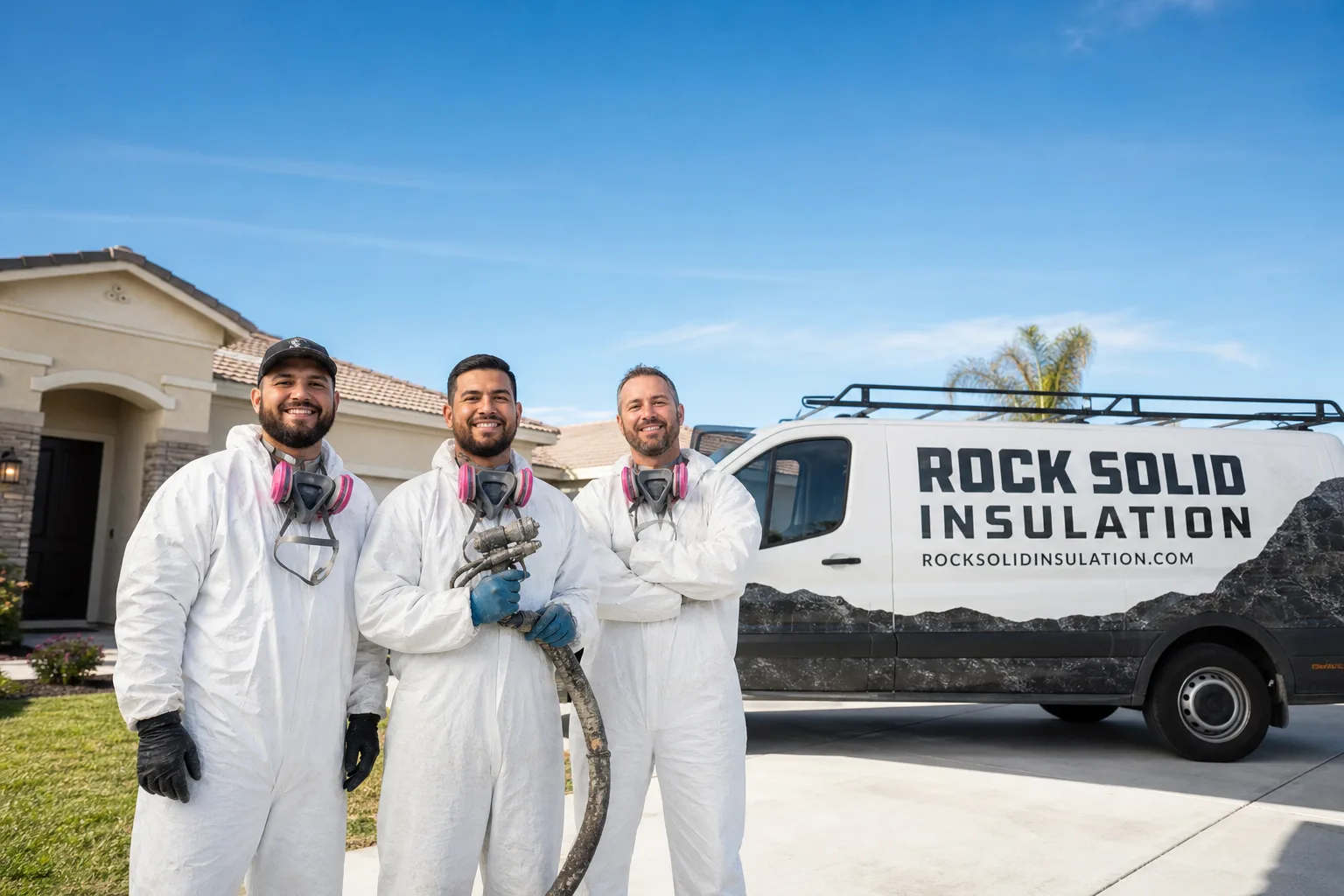
Fast, Reliable Spray Foam Insulation Across Riverside
Spray foam insulation in Riverside is a different job than it is 45 minutes west. Here, your attic regularly cooks past 100°F in July and August, and then a Santa Ana event arrives and tries to shove dust and embers through every vent opening you have. That combination means the foam you choose, how thick it’s applied, and how the vent edges are sealed matters more than the R-value printed on the can. We’ve worked Riverside attics from the 92503 corridor to the east-side subdivisions, and we know what holds up here and what quietly fails. If your energy bills spike every summer or your attic smells like baked dust after a wind event, call us at (855) 798-0822 for a straight answer and a free estimate.
Why Rock Solid Insulation Is Riverside’s Preferred Spray Foam Insulation Company
Most Riverside calls we get start the same way: a homeowner pulls down the attic ladder in June, feels a wall of heat, and finds insulation that looks thinner than it should. By then, the attic has already been losing the fight for weeks. We show up with a plan specific to inland-basin construction, not a generic pitch.
Our crews know Riverside’s housing stock firsthand. The 1920s-1950s bungalows near downtown and along the older 92503 corridors frame differently than the 1960s-1980s tract homes spreading east. Older Riverside homes often have open rafter bays and undersized soffit vents; newer ones have truss layouts that leave gaps at top plates and can-light housings. Both leak air, just in different places. Ruben Calloway built Rock Solid Insulation around the idea that the right product follows the building, not the other way around. That’s why we carry eight brands including Icynene and Demilec spray foam systems, Owens Corning, Johns Manville, and Knauf fiberglass, plus Rockwool mineral wool, and we install with three methods: attic, spray foam, and blown-in. The recommendation you get is driven by your attic’s actual condition, not by whatever product happens to be on the truck that day.
Response time to Riverside from our Ontario base is typically same-day or next-day for inspections. We don’t ask you to wait through a heat wave for an answer.
Spray Foam Insulation Contractors in Riverside
Spray Foam Insulation Contractors in Riverside handle a specific problem: attics and rim joists that leak conditioned air year-round, get punished by extreme attic heat in summer, and get attacked by wind-driven dust and embers during Santa Ana season. A proper spray foam job here means air-sealing the top plates, can lights, and any chase openings, then applying foam at the right thickness for the surface. In Riverside’s market, a standard attic air-seal with open-cell foam on a 1,200-1,800 square foot home typically runs $2,800-$4,600. Closed-cell roof deck applications run higher, usually $4,200-$7,800 depending on deck square footage and access.
Air Sealing Before Anything Else
Foam sprayed over a leaky top plate just hides the leak. On Riverside homes, we find gaps around recessed lights, plumbing chases, and interior wall cavities that let conditioned air pour into the attic all summer. Those get sealed before a drop of foam goes down.
Closed-Cell vs. Open-Cell in the Inland Basin
Open-cell foam works well in enclosed attic floors and interior walls. But for Riverside roof decks, where underside temperatures can exceed 140°F on a July afternoon, closed-cell foam from Demilec or Icynene is the only barrier that holds against radiant heat soak. We recommend by heat load, not by brand contract.
Spray Foam Attic Insulation in Riverside
Spray Foam Attic Insulation in Riverside has to solve two problems at once: killing the radiant heat that pours through the roof deck all summer, and keeping Santa Ana winds from undoing the air seal at the eaves. A well-executed Riverside attic foam job typically costs $3,400-$6,900 for the full air-seal, vent-edge treatment, and foam application, with the range driven by attic square footage, deck condition, and whether old insulation needs removal first.
Deck Foam and the 100-Degree Problem
In Riverside, a roof deck that isn’t sealed becomes a radiant heater pointed at your ceiling. Closed-cell foam applied at full thickness to the deck underside stops that heat transfer at the source. Applied too thin, and the deck still radiates, which is a failure mode we see on jobs from less experienced crews.
Vent Edges That Survive Santa Ana Season
Foam sprayed tight against a gable or soffit vent opening without ember-resistant screening becomes a dust trap. The first strong northeast wind drives fine particulate and embers straight into the foam edge. We rebuild vent edges with screening rated for ember intrusion, then foam around them. The air seal stays intact, and the vent keeps doing its job.
Trusted Brands We Service in Riverside
We stock and install Icynene and Demilec spray foam systems because both are performance-tested platforms for airtight envelopes, and we pair them with Owens Corning, Johns Manville, Knauf, and Rockwool where the application calls for batt or mineral wool. Having all of them available means a Riverside homeowner isn’t forced into a single-system answer. Parts and material for Riverside jobs typically arrive from our Ontario supply chain within a day, so we’re not holding up a heat-wave installation waiting on a truck from out of state. We recommend by performance data, not by which manufacturer gives us the best margin.
Common Spray Foam Insulation Problems We See in Riverside Homes
- Santa Ana wind blow-over: Attic insulation gets shoved against one wall or piled into a corner during a strong northeast wind event, leaving half the attic floor bare. We see this most in the 92505 and 92506 corridors near the eastern foothills, where wind funnels through canyons and hits roof vents at full force.
- Dust and ember intrusion at gable vents: Fine brown dust tracks into the attic past un-screened gable and soffit vents, coating insulation and finding its way into the foam edge. This is a Riverside-specific failure mode that coastal Orange County attics simply don’t experience.
- Closed-cell foam applied too thin on roof decks: With attic temperatures routinely past 120°F in July, under-thickness foam still lets radiant heat soak through. The deck never truly seals, and the homeowner sees little change in upstairs comfort.
- Settled 1960s-1980s batts under new foam: Original batt and blown cellulose in Riverside tract attics sags and compacts over decades of thermal cycling. If foam is sprayed over the collapsed layer without removing it, the gaps underneath stay open and the air seal is cosmetic.
Pricing for Spray Foam Insulation in Riverside, CA
Riverside spray foam pricing runs higher than the national average for two reasons: the attic square footage on Inland Empire homes tends to be larger, and the vent-edge and air-sealing work required here adds labor hours. A typical open-cell attic floor application runs $2,800-$4,600. Closed-cell deck foil runs $4,200-$7,800. Rim joist spray foam in a crawlspace or basement runs $900-$1,800 depending on the number of bays and access clearance. Garage ceiling spray foam typically runs $1,200-$2,400. Roof deck closed-cell over an attached garage runs $3,000-$5,500. Every estimate is free and specific to your attic, not a square-footage guess. Call (855) 798-0822 and we’ll come measure.
We Also Serve Cities Near Riverside
Rock Solid Insulation runs crews throughout the Inland Empire from our Ontario base, and we regularly handle Spray Foam Insulation work in Rubidoux, Glen Avon, Pedley, and Sunnyslope. If you’re in one of those cities and your attic is failing the summer heat test, we’re close by. Same scheduling, same crews, same direct pricing.
Serving Riverside, CA — Our Local Coverage Area
We’re based in the Riverside area and know this community well. Use the map below to see our service coverage — if you’re nearby, we can almost certainly help.
FAQs About Spray Foam Insulation in Riverside
Yes, but only if the settled material is removed or the air seal is addressed underneath it first. In Riverside’s 1960s-1980s tract homes, old batts and blown cellulose sag and compact after decades of thermal cycling. Spraying foam over that collapsed layer traps the gaps instead of fixing them. We remove the dead insulation, air-seal the top plates and penetrations, then apply foam at the correct depth.
We rebuild the vent edges with ember-resistant screening before foaming around them. That keeps wind-driven dust and embers from being pushed into the foam edge and attic space. Without the screening, a strong northeast wind event will grind particulate into the foam and degrade the air seal over time. This is standard practice on every Riverside attic we do, not an add-on.
That’s the classic signature of a Santa Ana wind event. Strong northeast winds enter through gable or soffit vents, push across the attic floor, and pile loose insulation against one wall. Homes along the eastern foothills and canyon corridors in the 92505 and 92506 areas get this worst. The fix is re-securing the insulation and screening the vents that let the wind in. Call (855) 798-0822 and we’ll inspect it this week.
Yes, on roof decks and rim joists, closed-cell foam outperforms batt insulation in Riverside’s climate by an order of magnitude. Batt slows heat transfer; closed-cell foam stops it. With attic temperatures over 120°F, a sealed deck keeps that heat from radiating down through your ceiling. For attic floors, open-cell works fine, but the deck is where Riverside heat actually wins or loses.
Within a week if you see dust staining around ceiling vents or notice insulation piled oddly near the attic access. The longer wind-blown dust sits in your attic, the more it works into the air seal and the more heat transfer you absorb over the following summer. Inspections are free, and we’ll tell you straight if the attic is fine or needs work. Call (855) 798-0822.
Written by Ruben Calloway, Owner at Rock Solid Insulation, serving Riverside and the Inland Empire with performance-first insulation solutions.