
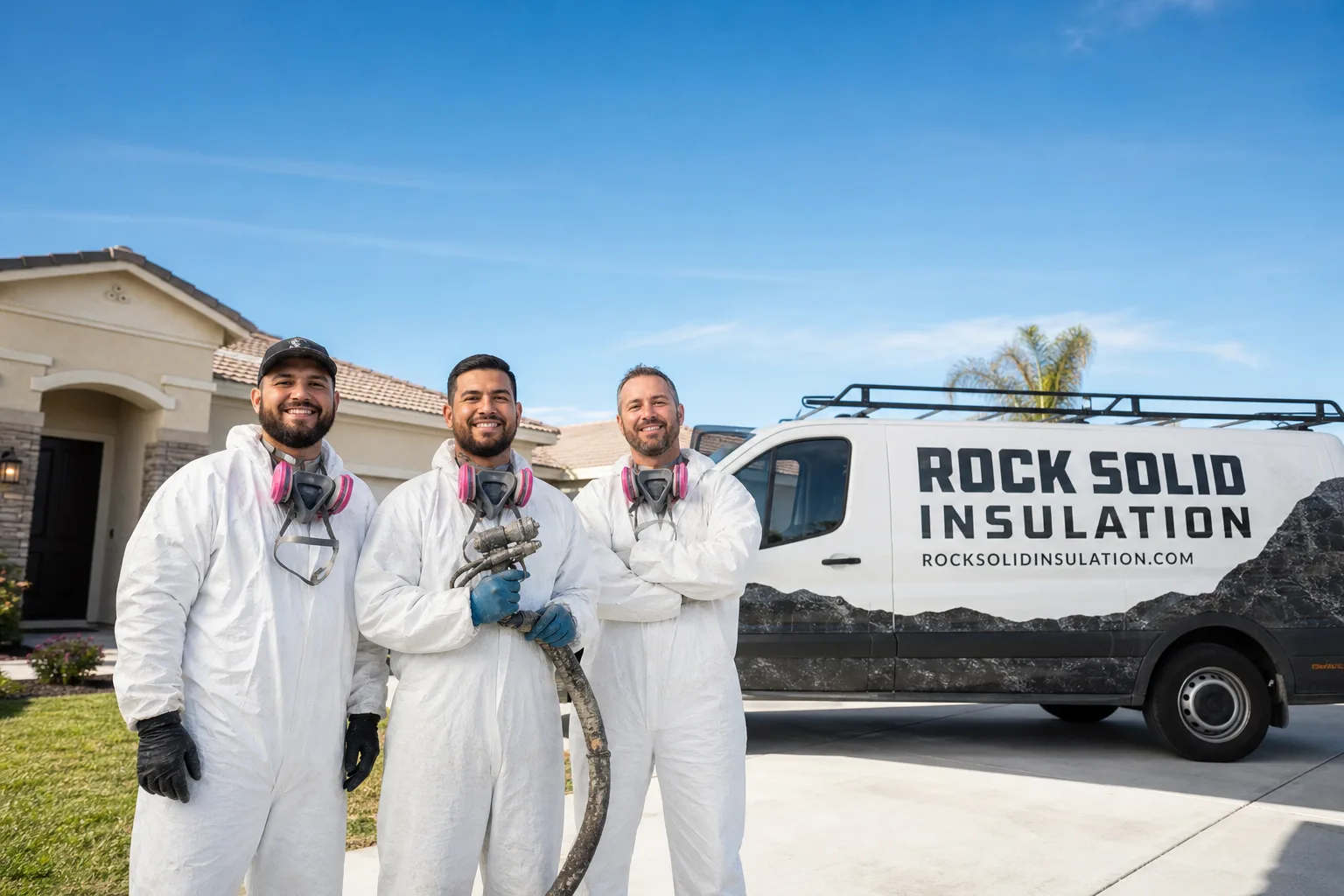
Fast, Reliable Spray Foam Insulation Across Mayflower Village
Spray foam insulation in Mayflower Village runs $1.80 – $4.50 per board foot installed, with a typical 200 – 300 square foot garage ceiling job landing between $1,400 and $3,200. Most jobs take one day. If you’re fighting a hot upstairs bedroom, a garage that radiates heat into the house, or energy bills that spike every July, the problem usually traces back to the hollow walls and settled attic insulation this neighborhood is known for. We’re Rock Solid Insulation, led by Ruben Calloway, and we work on mid-century ranch homes across 91006 regularly. Call (855) 798-0822 for a free estimate and we’ll tell you exactly what your home needs, not what we’re trying to unload.
Why Rock Solid Insulation Is Mayflower Village’s Preferred Spray Foam Insulation Company
We know what’s behind these stucco walls because we’ve opened enough of them up. Mayflower Village homes from the 1950s and 60s were built when energy was cheap and insulation was an afterthought. Many have zero wall insulation and attic fiberglass that’s compressed to under three inches. That’s not a guess, it’s what we find on nearly every ranch home we walk through off Santa Anita Avenue, around Mayflower Park, and throughout the surrounding streets. Our team knows which homes still have original knob-and-tube wiring, which means we sequence the work correctly: you handle the electrical, we handle the foam. Ruben Calloway has built our reputation on being direct about what’s safe and what’s not.
We carry eight nationally recognized brands and install spray foam, attic insulation, and blown-in under one roof. That matters here because the right fix for a 1958 ranch on a 7,000 square foot lot isn’t the same as the right fix for a newer Monrovia build. In Mayflower Village, we’re typically recommending closed-cell foam for rim joists and garage ceilings, open-cell for attic planes, and a hard look at the wall cavities before anything else. Our response time to most 91006 addresses is same-week, and we keep Icynene, Demilec, and other product lines stocked so we’re not waiting on a distributor when your attic is 140°F and climbing.
Garage Spray Foam Insulation in Mayflower Village
Garage Spray Foam Insulation is one of the highest-impact upgrades for Mayflower Village homes because most attached garages here were built with nothing between the garage ceiling and the living space above or beside it. The job involves clearing the ceiling and rim joist area, sealing any gaps around electrical boxes and plumbing penetrations, and applying foam directly to the ceiling plane and the band joist where the garage meets the house. It’s messy work that requires full protective gear and proper ventilation, so it’s not a weekend DIY project. For a standard two-car garage in Mayflower Village, you’re looking at $1,200 to $2,800 depending on ceiling height and access.
Attached Garage Heat Transfer
When a garage ceiling is uninsulated, the garage becomes an oven door attached to your living space. In July and August, we measure garage ceiling surface temperatures above 110°F on Mayflower Village homes. That heat bleeds through the drywall into adjacent bedrooms and hallways. Closed-cell foam at 2 – 3 inches cuts that transfer dramatically because it air-seals while it insulates, closing the small cracks that allow convection to carry heat upward.
Rim Joist Sealing in the Garage
Rim joists are the most overlooked air-leakage point in mid-century ranch construction. The gap where the floor framing meets the foundation wall lets outside air move freely into the wall cavities and up into the attic. In Mayflower Village, we regularly find daylight visible through these gaps. Sealing them with closed-cell foam stops the stack effect that pulls hot attic air into the home and pushes cooled air out.
Closed Cell Spray Foam Insulation in Mayflower Village
Closed Cell Spray Foam Insulation is the denser, higher-R-value option we recommend for Mayflower Village homes with limited cavity depth or moisture concerns. It applies as a liquid and expands to about an inch per pass, so we can build up thickness exactly where the framing allows. In a neighborhood where wall cavities are often just 3.5 inches deep, closed-cell gives you R-6.5 to R-7 per inch instead of the R-3.5 you’d get from fiberglass batts jammed into the same space. Pricing for closed-cell in Mayflower Village runs $2.80 to $4.50 per board foot, or roughly $3,500 to $7,800 for a typical attic roof deck.
Where Closed-Cell Earns Its Cost
Closed-cell foam is the only insulation that also functions as an air and vapor barrier. That’s valuable in Mayflower Village because the hot, dry summer air drives moisture from the living space into the wall assembly. If that moisture hits a cold surface, you get condensation inside the wall cavity. Closed-cell prevents the air movement that carries that moisture in the first place. It’s also structurally reinforcing, adding stiffness to aging framing that’s already carried this house for 60-plus years.
Rim Joist and Crawlspace Applications
For Mayflower Village crawlspaces, closed-cell is the right choice because the space is typically dusty, occasionally damp, and inaccessible enough that you only want to insulate it once. We foam the band joist from inside the crawlspace, leaving the foundation vents untouched. On a typical 1,200 square foot ranch, the rim joist job runs $1,100 to $2,400 and takes half a day.
Trusted Brands We Service in Mayflower Village
We’re not locked into one spray foam manufacturer, and that matters when you’re spending thousands of dollars on insulation. We install Icynene and Demilec spray foam systems because they’ve been performance-tested across every climate zone and carry the documentation to prove their R-values over time, not just on day one. For customers who also want Reflectix service in Mayflower Village, we can discuss how it fits alongside your foam project. For Mayflower Village customers who need blown-in or batt work alongside a foam project, we also stock Owens Corning, Johns Manville, and GreenFiber products. Keeping these materials on hand means we don’t make you wait two weeks for a truck to arrive from a distributor in another county. You call on Monday, we’re foaming by Thursday. Call us at (855) 798-0822 and we’ll tell you which product actually fits your home, not which one we happen to have a quota on this month.
Common Spray Foam Insulation Problems We See in Mayflower Village Homes
- Knob-and-tube wiring in wall cavities. Many 1950s Mayflower Village ranches still have active or abandoned knob-and-tube runs inside the walls. Spraying foam directly over live knob-and-tube can trap heat against aging conductors. The wiring has to be decommissioned by an electrician before we foam, and we’ll tell you if we suspect it’s present before any material goes on.
- Settled attic insulation under 3 inches. The original attic insulation in these homes has compressed, blown around, or degraded. If your August cooling bill is north of $400, check your attic depth. If it’s under 3 inches, you’re effectively living under a thin blanket on a hot roof. Spray foam on the attic plane resets that thermal boundary.
- Cracked stucco with unsealed penetrations. Santa Ana winds drive fine dust and occasional moisture into any crack or gap in aging stucco. If we foam the backside of that wall without sealing the exterior first, the foam edge becomes a collection point. We always recommend sealing exterior penetrations before or during a foam job.
- Rim joist foam pushing at exterior trim. Closed-cell foam expands with force. If it’s applied too heavily at the rim joist near a garage door opening or exterior trim piece, it can push that trim outward just enough to be visible from the street. In Mayflower Village, where the streetscape is a point of neighborhood pride, we control the pass thickness to avoid exactly this.
Pricing for Spray Foam Insulation in Mayflower Village, CA
Spray foam pricing in Mayflower Village tracks the LA County market: open-cell runs $1.80 to $2.80 per board foot, closed-cell runs $2.80 to $4.50 per board foot. A garage ceiling job lands between $1,400 and $3,200. A full attic roof deck on a 1,200 square foot ranch runs $3,500 to $7,800 for closed-cell. The variables are cavity depth, access clearance, and whether we’re also sealing rim joists or wall cavities. We give you a written line-item estimate before any foam goes on, and the price we quote is the price you pay unless you change the scope. Call (855) 798-0822 to get a free estimate for your specific Mayflower Village address. We’ll bring a thermal camera and show you exactly where your conditioned air is leaving.
Because Mayflower Village is unincorporated, not a city with its own municipal building department, spray foam retrofits here typically route through LA County rather than a city architectural review committee. And many mid-century ranch homes have no recorded CC&Rs on file at all. Whether an architectural review even applies often depends on deed restrictions recorded decades ago, not a current HOA office. That’s a different compliance picture than Arcadia or Sierra Madre, which is why we don’t copy-paste our approach from one city to the next. We’ll help you figure out what applies to your specific lot before you spend a dollar on foam.
On a ranch home off Santa Anita Avenue near Mayflower Park, our crew found the original stucco walls completely hollow and the attic insulation settled under three inches. We foamed the rim joists and attic plane with closed-cell Icynene while routing around the original knob-and-tube runs the homeowner had to have an electrician decommission first. We kept all foam and equipment inside the envelope so no exterior stucco patch touched the streetscape, and documented the wall-cavity depth and product data for the homeowner’s records in case a deed-restriction review ever comes up. That’s how we work: the foam stays where it belongs, and the paperwork stays ready.
For a broader look at how Spray Foam Insulation works and what it costs, you can read our full service guide. If you’re comparing Spray Foam Insulation in Mayflower Village against other contractors, that page will give you the local context you need to make a decision. Our Mayflower Village work is backed by the same standard we apply everywhere: the right product for the application, documented and installed cleanly.
We Also Serve Cities Near Mayflower Village
Our crews work throughout the west San Gabriel Valley. If you’re in Arcadia, Monrovia, Sierra Madre, or North El Monte, you’re in our regular service area and we can typically reach you within the same week. Mayflower Village may be small, but the surrounding communities share the same mid-century housing stock and the same heat, so we keep trucks staged nearby. Call (855) 798-0822 and we’ll confirm our next available slot.
Serving Mayflower Village, CA — Our Local Coverage Area
We’re based in the Mayflower Village area and know this community well. Use the map below to see our service coverage — if you’re nearby, we can almost certainly help.
FAQs About Spray Foam Insulation in Mayflower Village
Usually not from a city-level review board, because Mayflower Village is unincorporated and falls under LA County jurisdiction rather than a municipal ARC. The real question is whether your specific property has deed restrictions recorded decades ago that impose design or exterior change rules. Interior insulation work like spray foam typically doesn’t trigger exterior review, but we document everything in case a restriction applies to your lot. Call (855) 798-0822 and we’ll help you figure out what your property actually requires before any work starts.
Not directly over live knob-and-tube, no. Foam traps heat against aging conductors and creates a fire risk. The wiring has to be decommissioned or replaced by a licensed electrician first. We’ve handled enough Mayflower Village ranches to spot the telltale signs during the estimate, and we’ll flag it early so you’re not surprised mid-project. Once the electrical is safe, we can proceed with the foam work normally.
No. Garage ceiling and rim joist foam is installed entirely inside the garage or crawlspace, never on the exterior face of the house. There’s no stucco patch, no trim change, nothing visible from the sidewalk. In a neighborhood like Mayflower Village where the streetscape is continuous and houses sit close together, that matters. Your neighbors won’t know anything changed unless you tell them or unless your garage stops radiating heat like a furnace.
Closed-cell foam creates an air seal that settled fiberglass can’t. It stops the convection loop that pulls hot attic air into your living space and pushes cooled air out through every small gap in your ceiling plane. In Mayflower Village, where we get two or three straight weeks of 95°F-plus days, an air-sealed attic plane with R-21 closed-cell foam performs dramatically better than six inches of 60-year-old compressed fiberglass at roughly R-11 effective. You’ll feel the difference in room-to-room temperature consistency within days.
Almost never. Spray foam is an interior application: attic planes, garage ceilings, rim joists, and wall cavities accessed from inside or from the attic. The stucco stays untouched unless you have a separate exterior sealing or repair need. If you do have cracked stucco or unsealed penetrations, we’ll recommend getting them sealed before we foam behind that wall area, because wind-driven dust and moisture from Santa Ana events can wick into the foam edge otherwise. We don’t do stucco work ourselves, but we’ll coordinate with whoever does.
If you’re ready to stop paying for cool air that leaks out of your attic every afternoon, call Rock Solid Insulation at (855) 798-0822. We’ll walk through your Mayflower Village home with a thermal camera, show you where the heat is getting in, and give you a free written estimate for the foam work that actually fits your house. No pressure, no brand bias, just the right insulation for the way your home was built.
Written by Ruben Calloway, Owner at Rock Solid Insulation, serving Mayflower Village and the San Gabriel Valley.