
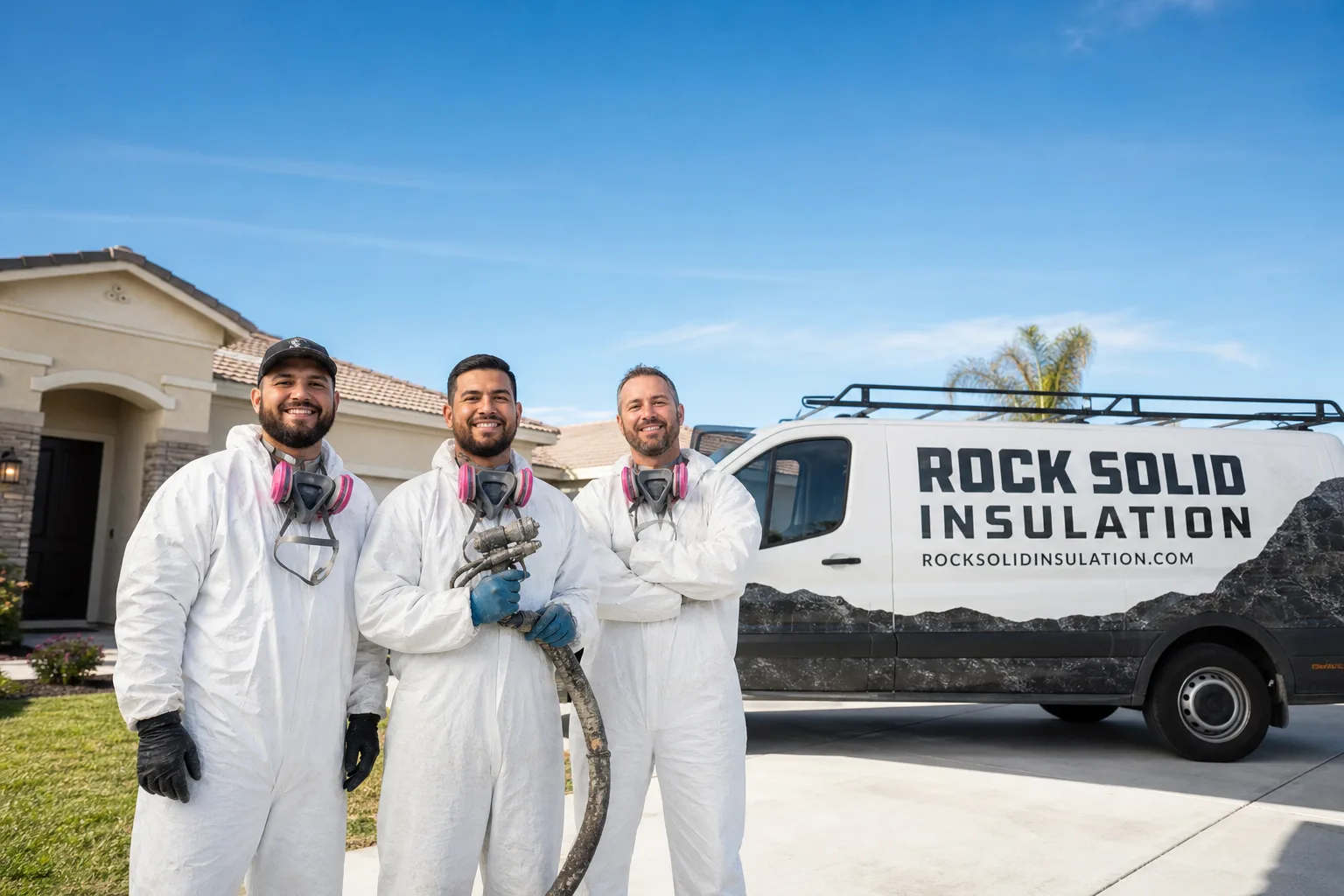
Fast, Reliable Spray Foam Insulation Across Highgrove
Spray foam insulation in Highgrove works differently than in coastal California because our attics routinely hit 140°F or more during summer afternoons. The heat load here means closed-cell spray foam on the roof deck, paired with attic ventilation and air-sealing, does the heavy lifting that wall insulation alone can’t. If you’re off Center Street or up near the unincorporated acreage east of La Cadena Drive, we can usually have a crew at your home within 24 to 48 hours. Call (855) 798-0822 for a free estimate and we’ll tell you honestly whether foam is even the right first step for your house.
Why Rock Solid Insulation Is Highgrove’s Preferred Spray Foam Insulation Company
Most Highgrove homes we walk into weren’t built for modern cooling loads. We see 1950s and 1960s single-story ranches with original fiberglass batts that have settled to R-19 at best, soffit vents painted shut, and attic floors with gaps around every can light and plumbing penetration. Homeowners here don’t need a contractor who just shows up with a foam rig and a script. They need someone who knows that an unvented attic off Center Street behaves completely differently in July than the same attic in coastal LA. That’s the work we do, and that’s why Ruben Calloway started positioning Rock Solid around diagnosis before product. We carry eight major insulation brands, but the first question on a Highgrove job is never “which foam do you want.” It’s “how is your attic currently vented, and where is the heat actually getting in.”
We work throughout 92313, from the older neighborhoods along Center Street and Main Street up to the larger-lot properties and rural remodels east of the 215. Response time to Highgrove is typically next-day for estimates, and because we stock materials for both open-cell and closed-cell applications, we’re not waiting on a supply house in San Bernardino to start your job. Homeowners here tend to have already tried the cheap fix, a few more batts from a big box store, before calling us. That’s fine. We’ll tell you what’s actually going on.
Closed Cell Spray Foam Insulation in Highgrove
Closed Cell Spray Foam Insulation is the workhorse for Highgrove attics where roof deck application is the goal. This high-density foam cures rigid, adds structural strength, and acts as both an air barrier and a vapor barrier at about two inches. In a hot inland basin like Highgrove, that matters because hot, humid attic air tries to condense on cooler surfaces during the overnight swing. Closed-cell stops that moisture migration cold. The material also carries a higher R-value per inch than open-cell, usually around R-6.5 to R-7 per inch depending on the system, which means a 3-inch lift on a roof deck gets you past R-20 while also sealing every seam and rafter bay.
A typical closed-cell spray foam roof deck application in Highgrove runs $3,200 to $6,800 depending on square footage, access, and whether we’re re-insulating after a rodent or moisture issue. If your home is one of the older ranches with minimal venting, the closed-cell route is often the best fit because it can be installed as an unvented attic assembly when paired with the right air-sealing strategy.
R-Value and Air Sealing in One Pass
The reason closed-cell outperforms fiberglass batts in Highgrove attics isn’t just the R-number. It’s that the foam expands into every crack, seam, and gap as it’s sprayed, creating a continuous thermal envelope. In homes built before Title 24 standards, those gaps around recessed lights, plumbing vents, and partition walls are where the real heat gains happen. Closed-cell addresses both insulation and air-sealing in a single application.
When Closed-Cell Is the Right Call
We recommend closed-cell for Highgrove homeowners when the attic will remain unconditioned, when roof deck insulation is the target, or when structural rigidity matters, like on an older roof that’s seen decades of thermal cycling. It’s also the preferred choice for rim joist applications where moisture from the crawlspace or basement can find its way in. The material cost is higher than open-cell, but the per-inch performance and moisture control justify it in the right assembly.
Open Cell Spray Foam in Highgrove
Open Cell Spray Foam remains a strong option for Highgrove attics where the goal is interior ceiling application rather than roof deck work. This half-pound-density foam expands aggressively, filling stud bays and rafter cavities completely, and it cures soft and flexible. The R-value runs around R-3.5 to R-4 per inch, which means you need more inches to hit the same thermal resistance as closed-cell, but the cost per board foot is meaningfully lower. For a Highgrove homeowner who wants better air-sealing than batts without the full closed-cell price, open-cell is often the honest recommendation.
A typical open-cell spray foam ceiling application in Highgrove runs $1,800 to $4,200 for an average single-story ranch. The material does an excellent job at sound attenuation too, which matters if you live off a street with traffic noise or near the rail corridor.
Where Open-Cell Fits Best
Open-cell works well on interior walls, cathedral ceilings where the roof deck is already vented, and in attics that will remain conditioned. It’s not the right product for a Highgrove attic that’s vented to the outside and will stay hot, because the foam’s open-cell structure doesn’t stop moisture vapor, and the material would just be insulating a hot space. We tell homeowners this straight: if your attic is vented and unconditioned, spraying open-cell on the ceiling is fine, but not on the roof deck.
Performance We Measure
After an open-cell application in Highgrove, homeowners typically see their AC runtimes drop during peak summer hours. The air-sealing benefit is the real win here, not just the R-value. Gaps that previously let 140-degree attic air pour through ceiling penetrations get sealed shut. The energy performance you get from open-cell in a ranch home here is something you can feel within a day or two, and we measure it with before-and-after thermal imaging when we can.
Trusted Brands We Service in Highgrove
We install Demilec and Icynene spray foam systems, two of the most performance-tested foam platforms in the industry, and we also carry Owens Corning and Johns Manville for fiberglass and mineral wool applications. Some Highgrove jobs call for a hybrid approach, closed-cell foam on the roof deck plus Rockwool in interior walls for fire resistance or soundproofing. Because we’re not locked into a single manufacturer, you get the product that fits your home’s construction, not the one we’re contractually obligated to push. Parts and materials for Highgrove jobs are stocked locally, so we don’t burn a week waiting on a shipment.
Common Spray Foam Insulation Problems We See in Highgrove Homes
- Foam over unsealed attic floors. In Highgrove’s older ranches, the attic floor is full of gaps around can lights, plumbing vents, and electrical chases. If spray foam is applied over these gaps without sealing them first, hot attic air bypasses the foam entirely. The thermal barrier fails no matter how thick the foam is.
- Trapped heat in under-vented attics. Pre-air-conditioning-era homes here were built with minimal venting. Add a modern AC system and a hot inland summer, and the attic becomes a convection oven. Foam applied without addressing ventilation can trap that heat and cause premature shingle aging or moisture problems.
- Foam adhesion over DIY-patched insulation. We frequently see attics where a previous owner threw new batts over old, sagging, rodent-soiled insulation. Spray foam doesn’t adhere properly to uneven, dusty, or deteriorated surfaces. The fix is removal or full air-sealing first, then foam on a clean substrate.
- Wrong foam for the wrong location. Some Highgrove homes have vented attics, some have unvented roof decks, and the two need different foam solutions. We’ve seen open-cell sprayed on roof decks in vented attics, which creates a moisture trap. The product choice has to match the assembly, not the price tag.
Pricing for Spray Foam Insulation in Highgrove, CA
For a typical Highgrove ranch home of 1,200 to 1,800 square feet, closed-cell spray foam on a roof deck runs $3,200 to $6,800. Open-cell ceiling applications run $1,800 to $4,200. Rim joist spray foam on a crawlspace foundation runs $900 to $2,400 depending on joist depth and access. Garage ceiling spray foam runs $1,400 to $3,100. Our estimates are free and we’ll give you a written number before any work starts. Call (855) 798-0822 and we’ll schedule a walkthrough within a day or two.
We Also Serve Cities Near Highgrove
From our base in Ontario, we run crews into Highgrove regularly and also cover Grand Terrace, Colton, Loma Linda, and Rubidoux. If you’re in any of those communities, you can read about our broader service area on the Highgrove page or see the full range of what we do on our Spray Foam Insulation hub. Same crew, same standards, same direct pricing.
Serving Highgrove, CA — Our Local Coverage Area
We’re based in the Highgrove area and know this community well. Use the map below to see our service coverage — if you’re nearby, we can almost certainly help.
FAQs About Spray Foam Insulation in Highgrove
Spray foam is an air barrier and an insulator, but in Highgrove’s hot inland basin, attic temperatures can exceed 140°F, and if your attic’s ventilation is inadequate, that heat has nowhere to go. Foam without ventilation and air-sealing can trap heat, cooking your shingles and making your AC work harder. The right sequence is air-seal the attic floor, improve ventilation, then apply foam. Call (855) 798-0822 and we’ll assess your specific attic assembly before recommending anything.
Schedule an attic inspection before buying insulation. Most Highgrove ranches from the 1950s and 1960s have minimal venting and settled or missing insulation, and the real problem is heat gain through the attic, not the walls. We’ll check your ventilation, attic floor sealing, and existing insulation condition, then tell you what needs to happen and in what order. Estimates are free.
The large diurnal swing here means your attic heats to extreme levels by late afternoon and cools rapidly at night. That thermal cycling puts stress on roof decking and causes moisture condensation when hot, humid air meets cooler surfaces. Closed-cell spray foam handles this better than open-cell because it’s a moisture and vapor barrier, but only when the attic assembly is designed correctly. We factor the swing into every Highgrove roof deck decision.
No, spray foam does not adhere properly to sagging, dusty, or deteriorated insulation. In older Highgrove homes, we typically remove the original batts, air-seal the attic floor, and then apply foam to a clean surface. This is one of those cases where the prep work matters more than the product. Call (855) 798-0822 and we’ll tell you what your attic actually needs.
We install Demilec and Icynene spray foam systems for most Highgrove work, and we also carry Owens Corning and Johns Manville for fiberglass and mineral wool needs. The brand follows the project, not the other way around. If closed-cell on a roof deck is the right call, we’ll recommend a Demilec or Icynene product rated for that application. If you need hybrid work, we’ll pair it with the appropriate brand for each layer.
Written by Ruben Calloway, Owner at Rock Solid Insulation, serving Highgrove and the Inland Empire.