
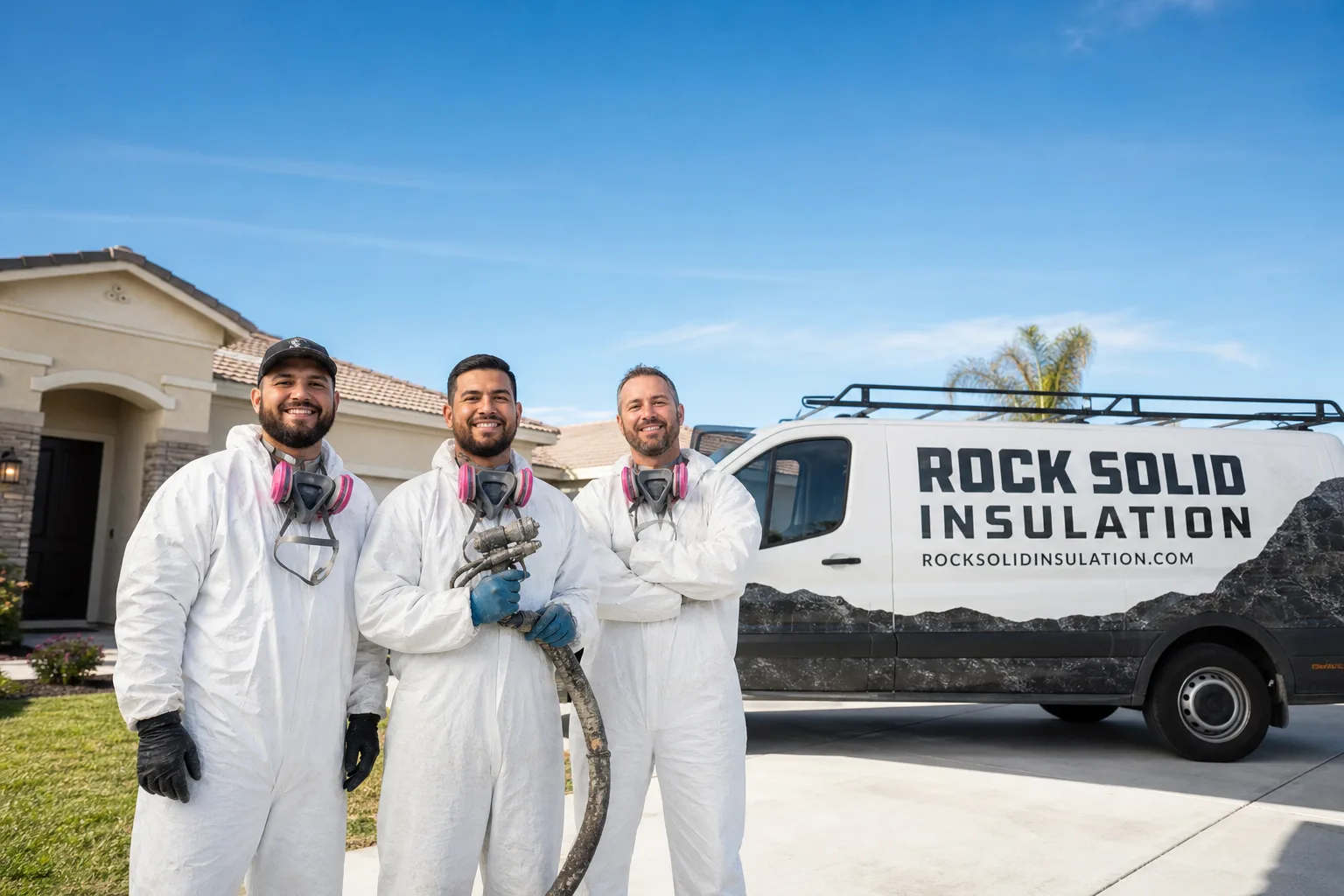
Fast, Reliable Spray Foam Insulation Across Covina
Spray foam insulation in Covina, CA typically costs $2,800 to $6,400 for a full attic application, with rim joist work running $900 to $2,200 and crawl space encapsulation between $3,500 and $7,500 depending on square footage. Most Covina homes we service are 1950s to 1970s tract builds where the original insulation has failed long ago. We know these houses. We know the low-pitch attics off Badillo Street, the single-story ranches north of Arrow Highway, and the way a Santa Ana wind event changes everything about how a building envelope should be sealed. If you’re reading this because your AC won’t keep up or you can feel air moving through your walls in January, call us at (855) 798-0822. We’ll give you a straight answer about what’s actually wrong.
Why Rock Solid Insulation Is Covina’s Preferred Spray Foam Insulation Company
Homeowners across Covina keep our number because we diagnose before we recommend. Ruben Calloway started this company on a simple principle: match the material to the house, not the house to whatever product we happen to stock. That means when we walk into a 1962 ranch in the 91724 ZIP with a low-pitch attic and original rock-wool batts, we don’t automatically say “spray foam everything.” Sometimes the right answer is air-sealing plus targeted open-cell foam. Sometimes it’s closed-cell on the rim joists and blown-in fiberglass above. We carry Demilec and Icynene spray foam systems alongside Owens Corning, Johns Manville, and GreenFiber products, so the recommendation follows the home’s construction and your budget, not a supplier contract.
Our crews work in Covina every week. We’re not driving in from across the county and guessing at your street’s drainage or sun exposure. We know that attics in the 91722 ZIP off Citrus Avenue hit 138°F by mid-morning in July, which is exactly why we schedule summer installs before 10am. We know which 1960s tract sections have the worst ember exposure when the Santa Anas blow. That local knowledge translates into a better install and fewer callbacks, and it’s why Covina homeowners keep referring us to their neighbors.
Rim Joist Spray Foam in Covina
Rim joist spray foam is the quiet fix that solves a problem most Covina homeowners don’t know they have. In a typical 1950s or 1960s tract home, the rim joist, or the band board where your floor framing meets the foundation wall, was left completely uninsulated at construction. That gap lets exterior air pour into the space between floors, and in Covina’s dry, windy conditions, it also lets dust and fine debris accumulate inside wall cavities. We regularly find rim joist bays in the 91722 ZIP packed with decades of wind-driven grit. Sealing those bays with closed-cell spray foam stops air movement at the source and gives you a real measurable drop in heating and cooling load.
For most Covina homes, rim joist spray foam runs $900 to $2,200 depending on foundation perimeter and access. It’s one of the highest-ROI insulation jobs we do, because the material goes exactly where the leakage is.
When Rim Joist Sealing Makes Sense
If your floors feel cold in January or you can smell crawl space air in the living room, your rim joists are likely the culprit. We recommend addressing them before adding attic insulation in older Covina homes, because sealing the bottom of the thermal envelope prevents wind-washed air from bypassing everything you install above. Homes built before 1980 in the 91723 and 91724 ZIPs almost always need this.
Closed-Cell vs Open-Cell at the Rim
We almost always specify closed-cell foam at the rim joist in Covina. It acts as its own vapor retarder, which matters in a climate with hot dry summers and occasional winter rain. Open-cell has its place in ventilated attics, but at the foundation line, closed-cell is the right call for durability and moisture performance.
Crawl Space Spray Foam Insulation in Covina
Crawl space spray foam insulation is a permanent fix for the cold floors and drafty rooms that plague Covina’s postwar tract housing, especially the single-story homes built between 1955 and 1975. Most of these houses sit on vented crawl spaces with exposed floor joists and fiberglass batts that are sagging, rodent-damaged, or simply gone. When we inspect those spaces under homes near Covina Park or along San Bernardino Road, we’re typically looking at dirt floors, but no vapor barrier, and rim joist gaps pulling in outside air. Sealing the crawl space walls and rim joists with spray foam changes how the entire house behaves.
In Covina, a full crawl space encapsulation with spray foam on the walls and a vapor barrier on the floor typically runs $3,500 to $7,500. Smaller jobs, like just sealing the rim joists in a vented crawl, start around $900.
Why Covina Crawl Spaces Fail
The problem isn’t just heat loss, it’s the dust and ember exposure. Santa Ana winds push fine particulate through foundation vents and into every gap in the floor assembly. Homeowners with allergies or sinus problems often notice immediate improvement once a crawl space in the 91722 or 91724 ZIP is properly sealed. In some Covina neighborhoods, the wind also carries embers from hillside brush fires right up against foundation vents, which is another reason sealing matters.
Vented or Sealed: What’s Right Here
In Covina’s hot-dry climate, sealing the crawl space typically outperforms venting, especially during summer when outside air is 100°F and bone dry. That hot air flowing under the house superheats the floor assembly. A sealed crawl space stops that thermal exchange entirely, and paired with a vapor barrier, it also protects the floor framing from the moisture that does collect during winter rains.
Trusted Brands We Service in Covina
Rock Solid Insulation installs Demilec and Icynene spray foam systems, two of the most performance-tested foam platforms in the industry. We also work with Owens Corning, Johns Manville, and GreenFiber for the fiberglass and cellulose applications where those products make more sense. Because we carry eight brands across three installation methods, our Covina customers get a recommendation driven by performance data and local conditions, not a supplier agreement. If your project calls for open-cell foam in an attic, we use Icynene. If the rim joists need closed-cell, Demilec goes in. The material follows the job, and we keep enough inventory on our trucks to handle most Covina projects without a parts run back to the yard.
Common Spray Foam Insulation Problems We See in Covina Homes
- Compressed rock-wool and settled fiberglass in 1950s-1970s tract attics. The original batts in homes across the 91722 and 91724 ZIPs have compressed to half their original R-value, and spray foam applied directly over them without removal traps heat and fails to air-seal properly. We remove the old material before any foam goes in.
- Spray foam degradation from extreme attic heat. Attic temperatures in Covina routinely exceed 140°F in summer, and uncured spray foam installed during peak heat can off-gas, shrink, or fail to adhere. We schedule summer work before 10am and use foam systems rated for high-temperature curing.
- Wind-driven dust and ember intrusion through rim joists and soffit vents. Santa Ana winds push fine particles and, in fire-prone years, embers into the gaps in older tract construction. Sealing those gaps with closed-cell foam is as much about resilience as it is about energy bills.
- Bypass air paths in low-pitch attics that render batts useless. In Covina’s shallow attic cavities from the 1960s, fiberglass batts often sit below top plates and can lights with no air barrier, letting wind-washed air flow straight through. Spray foam applied as an air-sealing layer fixes what batts alone never could.
Pricing for Spray Foam Insulation in Covina, CA
Here’s what we actually see on Covina jobs. A full attic air-seal with open-cell foam in a 1,100 to 1,600 square foot tract home runs $2,800 to $4,800. Closed-cell applications, which add structural rigidity and a vapor barrier, run $4,500 to $6,400 for the same space. Rim joist sealing lands between $900 and $2,200. Crawl space spray foam and encapsulation ranges from $3,500 to $7,500. The factors that move the number are square footage, attic accessibility, whether old insulation needs removal, and whether we’re also sealing duct penetrations or top plates. Every estimate we give Covina homeowners is free and itemized, and the price we quote is the price you pay. Call (855) 798-0822 and we’ll give you a number with no games.
We Also Serve Cities Near Covina
Our Spray Foam Insulation team covers Covina and the surrounding San Gabriel Valley communities, including Irwindale, Azusa, Citrus, and West Covina. If you’re in any of those areas and dealing with a failed attic or drafty rim joists, the same crew that knows Covina’s tract housing is minutes away. Visit our Covina page for more local details, or call (855) 798-0822 to schedule.
Serving Covina, CA — Our Local Coverage Area
We’re based in the Covina area and know this community well. Use the map below to see our service coverage — if you’re nearby, we can almost certainly help.
FAQs About Spray Foam Insulation in Covina
Because attic temperatures hit 140°F by late morning, and uncured spray foam applied in that heat risks off-gassing, poor adhesion, and shrinkage. In Covina’s inland valley climate, we do all summer attic installs in the early-morning window, typically starting at 6am and finishing the foam application before the heat becomes unworkable. This isn’t a scheduling preference; it’s a material-performance requirement. Call (855) 798-0822 and we’ll book your install for the right window.
No, and any contractor who says otherwise is cutting corners. In Covina’s 1950s and 1960s tract homes, the original rock-wool and fiberglass batts are compressed, dust-buried, and sometimes rodent-infested. Spray foam applied over that debris won’t adhere to the drywall and won’t seal the top plates where air actually leaks. We remove the old material, inspect the framing and electrical, and only then apply foam. The removal adds labor, but skipping it defeats the entire point of the job.
It seals the gaps embers use to get inside. In older Covina tract homes, the rim joists, soffit vents, and eave intersections are wide open to wind-driven embers and fine dust during Santa Ana events. Closed-cell spray foam fills those cavities and creates a continuous air and ember barrier along the underside of the roof deck and at the foundation line. It’s not a substitute for fire-rated construction or defensible space, but it does eliminate the gaps that wind exploits. In fire-conscious parts of the 91723 ZIP, we specify this deliberately.
Yes, almost always. The single-story tract homes built from the 1950s through the 1970s across Covina were framed over vented crawl spaces with no air sealing and no vapor barrier. That means cold floors in winter, hot air infiltration all summer, and dust from Santa Ana wind events. Sealing the crawl space with closed-cell foam and adding a vapor barrier converts that space into a conditioned buffer zone. Most Covina homeowners notice the difference in floor temperature and indoor air quality within days of the install.
We install Demilec and Icynene spray foam systems, both of which are performance-tested for the exact conditions Covina throws at a building envelope. For open-cell attic applications, Icynene is our standard. For closed-cell rim joist and crawl space work, Demilec goes in. We choose the brand based on the application, the climate, and the specific house geometry, and we’re happy to explain why a particular product fits your job. Call (855) 798-0822 for a free consultation and we’ll walk you through the options.
Written by Ruben Calloway, Owner at Rock Solid Insulation, serving Covina and the San Gabriel Valley.