
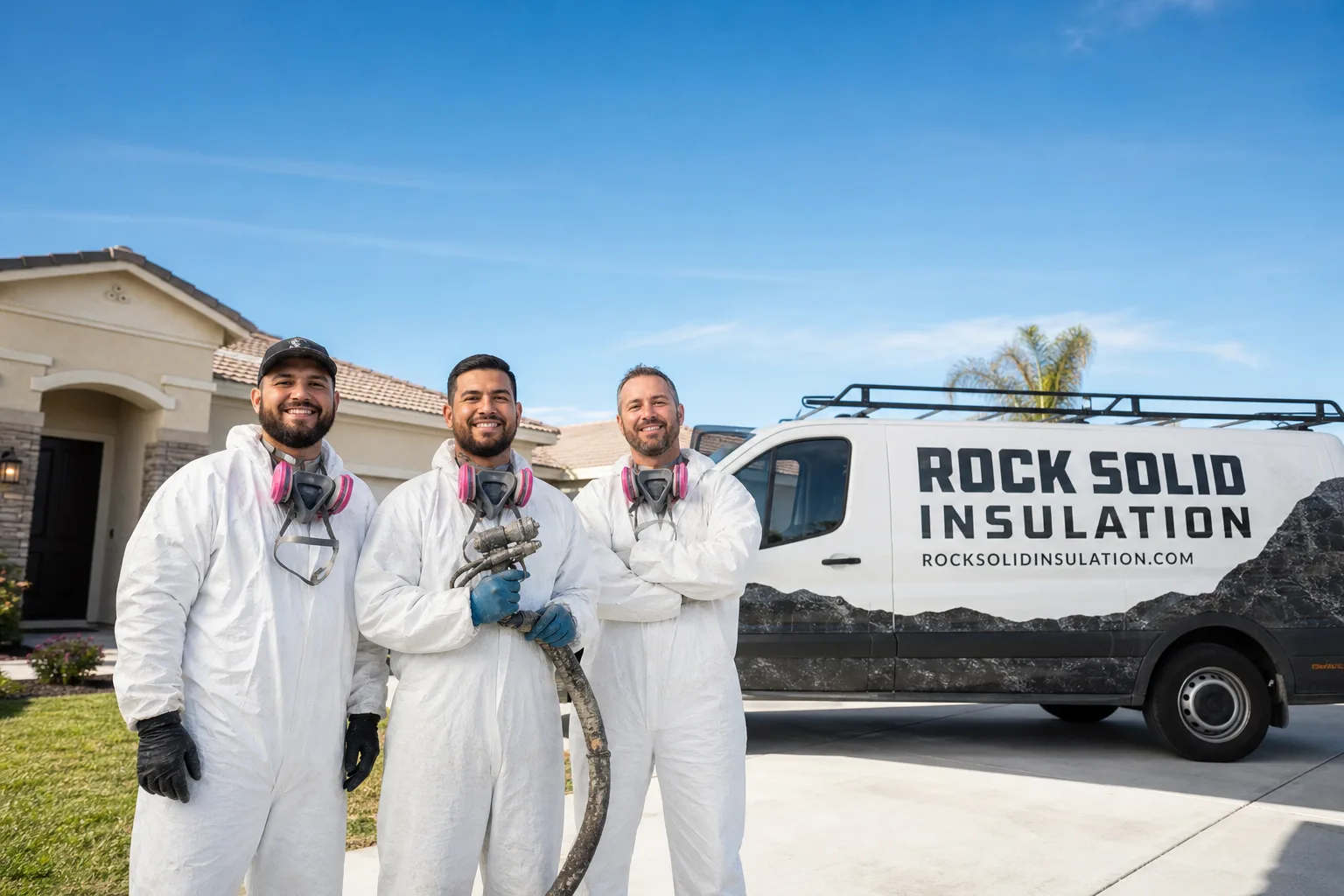
Fast, Reliable Spray Foam Insulation Across Azusa
Spray foam insulation in Azusa typically runs $2.50 – $6.50 per board foot installed, with most whole-attic projects landing between $3,800 and $9,200 depending on square footage and foam type. We’re out here every week, from the citrus-era bungalows north of Foothill Blvd to the foothill developments climbing toward the Angeles National Forest, and we’ve seen firsthand how Azusa’s housing stock creates insulation problems most generic contractors don’t know how to solve. When you call (855) 798-0822, you’ll get a straight answer about what your home actually needs, not a pitch for whatever product happens to be on the truck. Our Spray Foam Insulation team knows Azusa’s attics, walls, and crawl spaces better than a company that just punches the zip code into a GPS.
Key Takeaways
- Spray foam is often the only viable air-seal solution for Azusa’s pre-war wood-lath bungalows, where tearing out plaster isn’t practical.
- Closed-cell foam adds structural rigidity to older framing and doubles as a vapor barrier; open-cell foam is more cost-effective for attic rooflines and interior walls.
- Azusa’s summer attic temperatures regularly exceed 120°F, making proper ventilation during cure a critical quality factor many contractors overlook.
- Rodent-contaminated insulation in foothill-adjacent neighborhoods must be removed and entry points sealed before new foam goes in.
- Free estimates by phone: (855) 798-0822.
Why Rock Solid Insulation Is Azusa’s Preferred Spray Foam Insulation Company
Ruben Calloway built Rock Solid Insulation around a simple principle: match the material to the house, not the house to the material. That matters in Azusa because the housing stock is all over the map. One block you’re in a 1920s citrus-belt bungalow with original wood-lath walls and no cavity insulation. The next block is a 1960s tract home with slumped fiberglass batts. Head up toward the foothills and you’ll find newer infill construction that still benefits from upgraded air sealing. Most insulation companies carry one product line and apply it everywhere. We don’t. We carry Icynene and Demilec spray foam systems, Owens Corning and Johns Manville fiberglass, Rockwool mineral wool, and GreenFiber cellulose – and we recommend based on what your home’s construction actually calls for.
Response time to Azusa is usually same-week for estimates, and many spray foam projects can be scheduled within days. Our crews know the street layouts, the tight alley access behind downtown homes, and the parking constraints on hillside streets off North Azusa Avenue. We’re not guessing when we arrive. We’ve spent enough time in Spray Foam Insulation in Azusa to know what we’re walking into.
Open Cell Spray Foam in Azusa
Open Cell Spray Foam in Azusa homes is the workhorse for attic rooflines and interior walls – it costs $2.50 – $4.50 per board foot installed and creates an air seal that stops the convection loop that makes upstairs rooms unbearable in July. For older Azusa homes, open-cell foam is often the only way to insulate wall cavities without gutting the plaster. It expands to fill irregular spaces, gets into the gaps between wood lath and framing, and dramatically cuts air leakage. That matters when your walls were built before cavity insulation was even a concept.
Homeowners in the Citrus Avenue and North Azusa Avenue corridors often ask whether open-cell foam is enough for Azusa’s heat. The answer is yes, in the right application. Open-cell foam’s R-value per inch is lower than closed-cell, but its air-sealing performance is excellent, and in attic rooflines it prevents the radiant heat from the roof deck from turning the attic into an oven. The key is proper installation during summer months, when attic temps exceed 120°F. Foam needs to be sprayed within the manufacturer’s temperature and humidity window, and the space needs ventilation during cure. Cut corners on that and you get shrinkage and uneven adhesion.
Attic Roofline Air Sealing
Azusa attics with original wood shake or composition shingle roofs lose conditioned air through every gap between the roof deck and the framing. Open-cell foam applied to the roofline turns the attic into conditioned space, which means your HVAC ductwork isn’t sitting in a 130°F oven all summer. We see 20 – 30% energy load reductions on homes where we move the thermal boundary from the attic floor to the roofline. In foothill-adjacent houses with cathedral ceilings and no attic access, this is frequently the best-performing option.
Interior Wall Cavity Retrofit
For older Azusa homes with no wall insulation, open-cell foam can be injected through small access holes drilled in the plaster or drywall, then foamed into the cavity. It expands slowly, fills the space, and air-seals at the same time. The alternative – tearing out original lath and plaster to install batts – is a remodel-scale project. Open-cell foam retrofit is a one-day job for most single-story bungalows.
Spray Foam Insulation Contractors in Azusa
Spray Foam Insulation Contractors in Azusa aren’t all the same, and the differences show up in the details: whether they remove rodent-contaminated batts before spraying, whether they follow the foam manufacturer’s documentation for temperature and humidity limits, and whether they understand how closed-cell foam behaves in a 2×4 wall cavity in a 1930s house. We carry both Icynene (open-cell and closed-cell) and Demilec (both chemistries) because the right choice depends on your specific application. Closed-cell foam at $4.50 – $6.50 per board foot adds structural rigidity and acts as a vapor barrier – useful in Azusa basements, rim joists, and anywhere moisture is a worry. Open-cell foam at $2.50 – $4.50 per board foot is the better value for attic and interior wall air sealing.
A real problem we see in Azusa specifically: crews that show up, point a foam gun at the attic, and spray over whatever insulation is already there. If roof rats from the foothills have tunneled through the existing batts, you’ve just sealed urine-scented, feces-laden material into your ceiling. We remove and replace contaminated insulation before applying foam. That’s the difference between a job that solves your problem and a job that makes it worse.
Rim Joist and Crawl Space Sealing
The rim joist – the perimeter band where your floor framing meets the foundation – is one of the biggest air leakage points in any Azusa home, and closed-cell foam is the right product here. It seals the gap, adds structural strength, and blocks moisture migration from the crawl space into the floor system. Two-story homes and older bungalows with raised foundations benefit the most.
Garage and Band Joist Applications
For attached garages, the shared wall and ceiling between the garage and living space matter. Closed-cell foam on the garage ceiling stops the “hot garage” heat from bleeding into the bedrooms above – a common Azusa complaint in summer. We also handle detached garage conversions, which have become popular in the citrus-belt neighborhoods where homeowners add ADUs.
Trusted Brands We Service in Azusa
We’re brand-neutral because we have access to eight nationally recognized product lines, including Icynene and Demilec spray foam systems, Owens Corning fiberglass, and GreenFiber cellulose. No exclusive supplier agreements means our recommendations are driven by your house, your budget, and your performance goals. For Azusa homeowners specifically, we keep the most commonly specified foam chemistries and fiberglass products stocked for fast turnaround. If you’ve got a room that won’t hold temperature and you’re in 91702, call (855) 798-0822 and we’ll tell you honestly what product fits the job – not the other way around.
Common Spray Foam Insulation Problems We See in Azusa Homes
- Foam sprayed over rodent-contaminated batts: In older neighborhoods north of Foothill Blvd, roof rats and squirrels from the foothills tunnel through attic insulation. Some contractors spray right over it, sealing in odor and urine. We remove it first, seal the entry points, and only then apply foam.
- Off-ratio foam in tight wood-lath wall cavities: Improperly mixed foam shrinks and pulls away from the lath, losing adhesion and air-seal performance. Older Azusa homes with irregular wall cavities are more sensitive to this than uniform 2×4 tract framing.
- Inadequate ventilation during summer attic sprays: When attic temps hit 120°F or higher, the foam cure reaction generates additional heat. Without proper ventilation, you get off-gassing, uneven cell structure, and reduced R-value. We schedule summer Azusa attic work early in the day and ventilate per manufacturer specs.
- Ignoring the wall-roof air-seal connection: Spraying the attic roofline without sealing the wall top plates leaves a gap where conditioned air escapes into the wall cavity. This is particularly common in older Azusa bungalows with true 2×4 walls and no top plate sealing.
Pricing for Spray Foam Insulation in Azusa, CA
For Azusa’s housing stock, here’s what we actually quote: open-cell foam runs $2.50 – $4.50 per board foot installed, and closed-cell runs $4.50 – $6.50 per board foot. A typical 1,200-square-foot attic roofline with open-cell foam in a citrus-era bungalow runs $3,800 – $5,500. A full closed-cell rim joist and crawl space package for a 1960s tract home typically lands between $2,800 and $4,200. Wall cavity injection in an older wood-lath home varies based on access and wall thickness, but most single-story homes come in between $6,000 and $11,000 for complete wall coverage. Attic temps, access difficulty, and whether contamination removal is required all affect the final number. Estimates are free – call (855) 798-0822 and we’ll walk through your project and give you a real number.
We Also Serve Cities Near Azusa
From our Ontario headquarters, our crews regularly work Azusa, then head out along the 210 and 605 corridors to Citrus, Irwindale, Covina, and Glendora. If you’re just over the city line in one of these neighboring communities, same scheduling and pricing apply. The foam products, the crews, and the quality standards don’t change – only the commute does.
Serving Azusa, CA — Our Local Coverage Area
We’re based in the Azusa area and know this community well. Use the map below to see our service coverage — if you’re nearby, we can almost certainly help.
FAQs About Spray Foam Insulation in Azusa
Yes, but not by injecting it through the plaster surface. The right technique is to drill small access holes through the plaster and inject foam into the wall cavity from the interior or exterior, letting it expand behind the lath. Spraying foam directly onto the interior face of lath and plaster defeats the purpose – you’re not air-sealing the cavity, you’re just adding a surface layer. Our crews perform cavity injection on these homes regularly, and the air-sealing result is dramatic. Call (855) 798-0822 to discuss your specific walls.
Spray foam creates a continuous air barrier that dramatically reduces the number of entry points for smoke to enter your home during Santa Ana wind events. Open-cell foam in the attic roofline and closed-cell foam at the rim joist and wall top plates stop the stack effect that pulls smoky air in through the lower house and exhausts it through the attic. During wildfire season, that air sealing can mean the difference between a house that smells like campfire and one that doesn’t. For maximum protection, pair foam air sealing with a MERV-13 or higher furnace filter.
Closed-cell foam has the higher R-value per inch, so for Azusa attics that bake in the San Gabriel Valley heat, closed-cell foam on the roofline gives you the most thermal resistance in the least space. But open-cell foam is a common alternative that performs well when applied to the attic floor or roofline, especially in older homes where cost is a consideration and the air-sealing benefit matters more than maximum R-value. The honest answer is that both work – the right choice depends on whether you’re conditioning the attic space, what’s already up there, and what your budget is. We’ll spec it based on those factors, not on which product we’d rather sell.
Yes, if the existing insulation is rodent-contaminated, water-damaged, or otherwise compromised. In Azusa’s foothill-adjacent neighborhoods, roof rat infestations in attics are common, and spraying foam over tunneled, urine-soaked batts seals the problem into the house. We remove the contaminated material, seal the entry points with exclusion work, and only then apply foam. If the existing insulation is clean and dry, it can often stay in place depending on the application. The inspection we do during the estimate answers this question definitively.
Spray foam application requires less staging room than blown-in or batt insulation, which makes it well-suited for Azusa’s tight lots, alley-load garages, and hillside streets with limited street parking. Our rigs are compact enough to set up in a driveway or on a single-lane street without blocking access. For homes with no driveway or alley-only access, we frequently run hoses from the street to the attic, which adds some labor but doesn’t compromise the quality of the install. Call (855) 798-0822 and we’ll have a plan for your specific property before we arrive.
Get Your Free Azusa Spray Foam Estimate
If your Azusa home is hot upstairs, drafty in winter, or you can smell wildfire smoke the moment the Santa Anas kick up, spray foam is a real solution – but only if it’s the right product, applied correctly, in the right place. That’s what we figure out first. Call (855) 798-0822 for a free estimate, or ask for Ruben directly. We’ll walk your attic, look at your walls, and give you an honest recommendation with a real number attached. No pressure, no one-size-fits-all pitch. Just the right insulation for how your house was actually built.
Written by Ruben Calloway, Owner at Rock Solid Insulation, serving Azusa and the San Gabriel Valley.